

“There are still genetically modified crops that are still being forced to be introduced and tried to plant in our farms even though for several decades it has been proven that it poses many risks and diseases not only to health but also to the economy and environment of the Philippines.”
LEGAZPI CITY, Albay – It has been 13 years since 400 Bicolano farmers and activists made history uprooting the genetically-modified golden rice from the experimental farm of the Department of Agrarian Reform (DAR) in Pili, Camarines Sur.
Mamerto ‘Pay Merto” Pado, an 84-year-old farmer and a rice breeder from Pamplona, Camarines Sur, will never forget that day. He said the uprooting was successful because it was well-planned.
“The guards thought we were just going to have a dialogue, but when the gate was opened, the farmers rushed in like flood,” Pado said.
It was on August 8, 2013 when Bicolano farmers decided to take action against the golden rice field trials after receiving warnings from concerned scientists and peasant leaders about its dangers to health and its threat to biodiversity.
The uprooting of genetically modified rice gained international support. An Asian-wide coalition of farmers in nine countries, under the Asian Peasant Coalition (APC), lauded their protest action that encouraged collective action. August 8 has also been declared as the International Day of Action Against Golden Rice.
Pado organized their association in the Bayanihan Farmers Organizations (BFO) and mobilized more than 30 people to join the uprooting. “The entire organization knew for sure that the golden rice contained GMOs (genetically modified organisms) that would harm human health,” Pado said.
On August 8, 2026, Pado and other farmers from the Kilusan ng Magbubukid ng Bicol commemorated the 13th year anniversary of the historic uprooting of the genetically-modified golden rice.
A forum and workshop was held during the commemoration in Legazpi City joined by various Bicolano farmer-trainers, agricultural technicians, and sustainable agriculture practitioners to consolidate their experiences in sustaining the campaign against golden rice and promoting sustainable organic agriculture in the Bicol region.
According to Kilusang Magbubukid ng Bicol (KMB), the spirit of the historical action remains alive. “The unity we showed back then gave us the strength to reject golden rice and oppose a program that was useless to Filipino farmers,” KMB spokesperson Regina Barbacena said.
Matias De Mesa, a 73-year-old farmer and an electrician from Camaligan, Camarines Sur recalled his experience during that day of the uprooting.
“I was the one who took the lead in testing the power line. I checked if there was electricity [in the fences]. When [I signaled that] there’s none. In one, two, three, they pushed the fences. Then, they broke it down,” De Mesa said.
“When the entire organization is truly united, members would always work diligently for the good of the entire community,” Pado said.
Read: Farmers in Bicol uproot golden rice
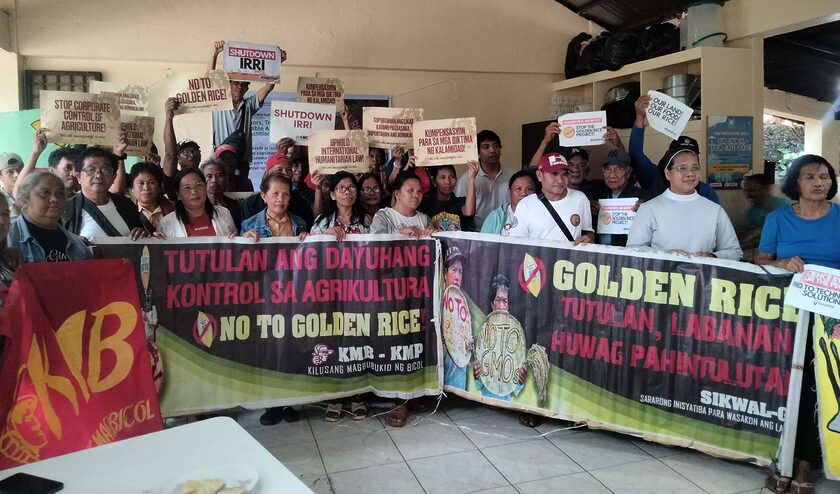
SIKWAL-GMO and Kilusang Magbubukid ng Bicol consolidate the farmers’ experiences to sustain the campaign against Golden Rice. Photo by Reynard Magtoto/Bulatlat
Organic farming as alternative
The farmer-led network, Magsasaka at Siyentipiko para sa Pag-unlad ng Agrikultura (Masipag), launched forums and educational campaigns in Catanduanes, Albay and Camarines Sur against golden rice and promoting organic farming as an alternative.
“They understood better that golden rice should not be favored because there are many alternative seeds that are more suitable to their area. A people’s organization in Catanduanes that is mass producing Masipag rice and traditional varieties that have yielded good harvests,” said Roland Labrador, area coordinator of Masipag Luzon.
Farmer technician Jake Abila cited the importance of sustainable organic farming. He said it is sustainable – the costs are low and the yields are high.
Roland Labrador, area coordinator of Masipag Luzon added that farmers have asserted their rights to seeds, land, and appropriate sustainable technology.
Vigilance
According to Masipag, the danger of GMO crops remains.
“We are really seeing the spirit of their mobilization in 2013, which compelled us to file a legal case in 2022 to stop the golden rice,” said Masipag National Advocacy Officer, Elizeo Ruzol Jr.
On October 17, 2022, Masipag and other anti-GMO groups filed a petition for writ of kalikasan and continuing mandamus before the Supreme Court (SC) against the testing, propagation, and use of Malusog Rice and Bt Talong. The SC referred the case to the Court of Appeals (CA) that eventually granted their petition on April 17, 2024.
The Malusog Rice Program cultivated golden rice from 2022 to 2023 in pilot provinces such as Maguindanao, Quirino, Catanduanes, Samar, Antique, Lanao del Norte, and Agusan del Sur. The Program’s operations are currently on hold due to the compliance of DA-PhilRice with the CA ruling.
Through the Office of the Government Corporate Counsel, DA-PhilRice filed a petition on October 24, 2024 to the SC seeking to overturn the decision of the CA, emphasizing the nutritional value and potential health benefits of Malusog Rice. The high court is yet to decide on the appeal.
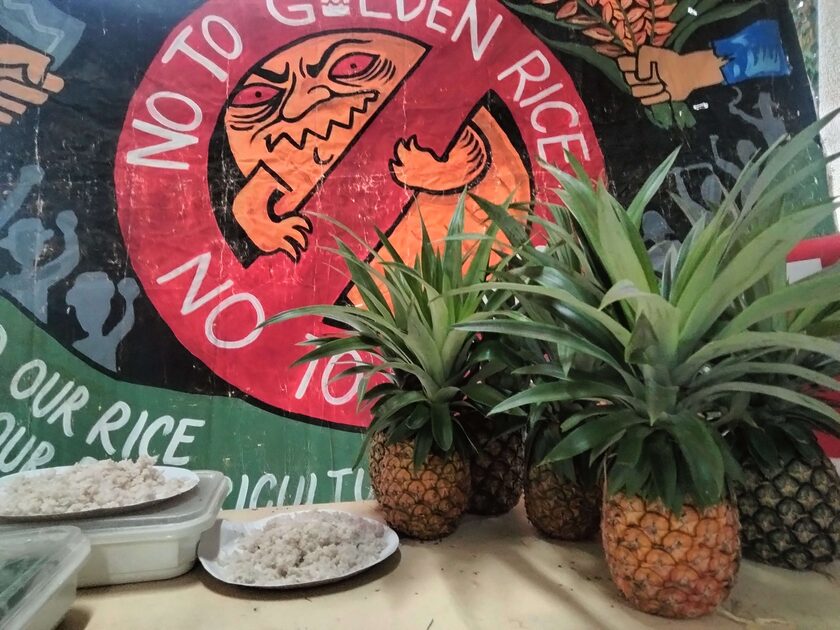
Peasant groups believe that the younger generation can sustain the farmers’ fight for better harvest and livelihood. Photo by Reynard Magtoto/Bulatlat
“There are still genetically modified crops that are still being forced to be introduced and tried to plant in our farms even though for several decades it has been proven that it poses many risks and diseases not only to health but also to the economy and environment of the Philippines,” said Ruzol.
The golden rice trial farms were initiated by Syngenta and the International Rice Research Institute (IRRI). Syngenta is a state – owned global agricultural technology company based in Basel, Switzerland with an office branch in Muntinlupa City while IRRI is an international agricultural research and training organization based in Los Baños, Laguna with offices in 17 countries from Asia and Africa.
“We will once again consolidate and build on the experiences from the August 8 action to further strengthen our campaign against foreign domination and advance a sustainable agriculture program that is pro-farmer and pro-environment,” said Barbacena. (AMU, RVO)
The post From uprooting GMO rice to planting own rice varieties, Bicolano farmers promote organic farming appeared first on Bulatlat.
From Bulatlat via This RSS Feed.