

You must log in or # to comment.
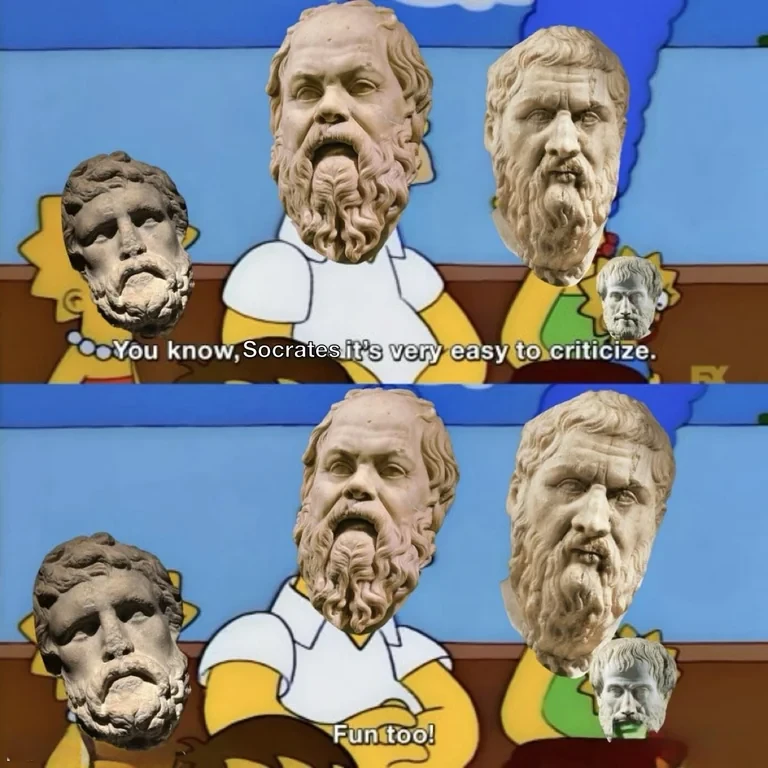
Explanation: The Ancient Greek philosopher Socrates was renowned for his argumentative ability, and, especially, in his ability to deconstruct the positions of others. He himself noted that he ‘knew nothing’ - by operating without (or at least, while minimizing) preconceptions, he managed to be an extremely persuasive debater and conversationalist. He took pride in being a ‘gadfly’, irritating others by pointing out flaws and issues in their courses of action, and did so energetically and with humor.
… it made him some enemies. After an unpopular oligarchy in Athens was overthrown, Socrates was put on trial for ‘misleading the youth’ by the revived Athenian democracy. Socrates was not a friend of democracy, but also was not involved with the Athenian oligarchy, which he regarded as corrupt; some of his students were involved with it, however, and that doubtlessly colored perceptions of his rhetoric. Despite jovially suggesting that his punishment should be to be honored and given a pension (and then, after that fell flat as a ‘plea’, offering to pay a substantial fine despite his relative poverty), he was condemned to death, and would commit suicide by drinking hemlock with poise and dignified detachment, despite having ample opportunity to escape into exile, as he regarded his duty to his city-state’s laws as greater than whether he agreed with any decision of it in particular.
Later the Athenians would recognize their mistake and actually vote to honor him with a bronze statue at public expense.
… a bit hard to take back, that one.