TIL the US government was still issuing hard drugs this century. Also not sure how this incident never gets mentioned in Canada anymore, and embarrassed that I hadn’t heard of it.
I should look for an introduction to the war’s actual internal history. By the 10’s it had become a kind of background war, nobody in the general public or media was really talking about battles or objectives, just casualties and ideology.
A big issue is that questions of battles and objectives were secondary at that point to casualties and ideology. By late 2002, the Afghanistan War was largely over in conventional terms - the tattered remains of the Northern Alliance had been assisted to victory, and the formation of a national government, by Coalition military support. Only in 2003 was there a serious resurgence of the Taliban with the international chaos caused by the Iraq War, which would define the battlefield in Afghanistan from then-on.
Insurgencies often ‘succeed’ not by traditional occupation of an area, but by sufficient denial of the standing power’s ability to do so. In other words, it’s not that the Taliban held Town A, B, and C; but rather that Coalition forces were put into a no-win position with Town A, B, and C.
You can support the people there with the ‘hearts and minds’ initiatives of the government, but as long as there’s a Taliban presence, you can’t guarantee that any of that supply will improve anyone’s life, or not be stolen by the insurgents. But if you ignore the town’s welfare, why would they not resent the ‘ruling’ power? So you’re stuck either investing great amounts of money that you have to assure your higher-ups is totally worth it despite minimal returns; giving the people a bare minimum of assistance, but not actually improving anything; or abandoning them for all-but-security concerns, at which point the people wonder “Why not the Taliban? They at least have SOMETHING to offer.”
You can commit enough troops to protect the people there from the Taliban acting a secondary government - which is expensive both in money and manpower, both of which are limited. But that itself is a dangerous move - ordinary servicemen are not trained for ultra-specialized culturally sensitive policing duties against un-uniformed insurgents. You can invest more in training and restrictive RoE (“Rules of Engagement” - the exact circumstances a soldier is allowed to attack an enemy or suspected enemy) to try to minimize the friction a bunch of armed 18 year-olds trying to hunt other armed 18 year-olds would cause, but training takes time and resources, while restrictive RoE inevitably degrades morale as soldiers ‘feel’ they should be allowed to attack when under threat - or worse, see one of their comrades killed or wounded while RoE does not allow engagement. And degraded morale can lead to things like the RoE being violated or ignored - setting you back at square 1 - not to mention the manpower losses from casualties.
You can get the national government involved more thoroughly - but that requires the national government to be competent, powerful enough, and not corrupt. No new government is going to be powerful enough to deal with every crisis zone during an insurgency, so this is already not available in all cases - but any use of coalition forces itself also implies weakness on the part of the national government and degrades its legitimacy. You can try to strengthen the national government, but if the national government is corrupt, much of that assistance will end up useless, or even sold to the insurgency. And you can try to weed out corruption from the national government, but the Coalition can only guarantee that if they’re directing anti-corruption efforts itself (assuming minimal corruption on the part of the occupying power, which is not always the case) - and if the Coalition is directing the government itself, the national government has no legitimacy since it is literally and transparently a puppet - making all of its efforts synonymous with the deployment of Coalition forces, at least in the short term.
You can try to empower local resistance against the insurgents, but in doing so, you have to rely on traditional power structures - which rarely align with the occupying power or national government. Just because they’re enemies with the insurgents doesn’t mean they’re friends with you; they will only side with you so long as you offer a better deal. This can be marginalized groups, ethnic minorities, or local warlords, but the outcome is generally the same - they have all the leverage in negotiations, while your leverage remains minimal. You need them just to not side with the insurgents, and they know this when you try to impose any other conditions; whereas they need you to offer more than whatever neutrality or alignment with the insurgents will gain them, and more than what opposition to the insurgents will lose them in addition.
In addition, Afghanistan does not have much of a history as a modern state, making legitimizing the national government very difficult. There’s not a strong sense of being an Afghani, there’s a strong sense of being a Pashtun, a Tajik, Uzbek, etc. The borders mean little, and the government which claims those borders, even less.
And on top of that, Pakistan regarded the Taliban as its creation and catspaw from the start. Pakistan’s main intelligence service was instrumental in funding and guiding the Taliban’s rise to power, and they never wanted to fully let go of that asset. Yet at the same time, they were the only country bordering Afghanistan who was friendly enough for us to move significant assets through. So we had as our only ‘ally’ in the region a country playing the Taliban’s side - or at least the side of indefinite Taliban survival.
Throw in the aforementioned Iraq War suddenly making it seem like the USA was just an enemy of Muslims in general, with its neo-crusader posture and rhetoric, and you have the recipe for massively increased appeal to Taliban resistance, even when just a year or two before the Taliban’s name was mud. Add in the flow of foreign funds and aid from jihadist groups and wealthy individuals to the Pakistani ISI’s enduring support, and you have one long-running, unresolvable Afghanistan War. All that matters at that point is force generation and will - that is to say, which side can outlast the other at the current rate of military engagement.
On paper, the national government could have crushed the Taliban on its own, but only on paper - the balance of power by the end of the Coalition-supported government remained very fragile. When a deal was made with the Taliban by the American administration over the Coalition-supported government’s head, and against their objections, it stripped not only legitimacy (and thus willingness to fight for) from the government, but also signaled that the Coalition would no longer oppose the Taliban - and the terms included the strong implication of US acceptance of an eventual Taliban victory. Why fight if no one else is going to fight? People will sometimes take long odds, but rarely martyrdom for no gain. On top of that, the final withdrawal deal included the release of 5,000 experienced Taliban fighters - around 10% of the force of the final Taliban offensive.
So ends the entire fucked scenario, now with the Taliban in charge and banning women from speaking in public.
Sounds like the first year is all I’ll need to really worry about in detail, then. Although, if I wanted gory detail, this thing exists and is the only work on any war I’ve ever heard of that’s contemporary, editorially independent and written with total access at the same time.


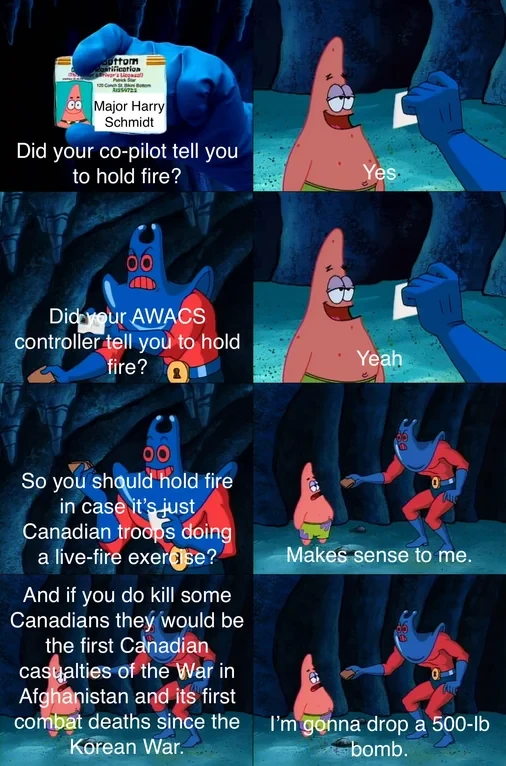
TIL the US government was still issuing hard drugs this century. Also not sure how this incident never gets mentioned in Canada anymore, and embarrassed that I hadn’t heard of it.
I should look for an introduction to the war’s actual internal history. By the 10’s it had become a kind of background war, nobody in the general public or media was really talking about battles or objectives, just casualties and ideology.
A big issue is that questions of battles and objectives were secondary at that point to casualties and ideology. By late 2002, the Afghanistan War was largely over in conventional terms - the tattered remains of the Northern Alliance had been assisted to victory, and the formation of a national government, by Coalition military support. Only in 2003 was there a serious resurgence of the Taliban with the international chaos caused by the Iraq War, which would define the battlefield in Afghanistan from then-on.
Insurgencies often ‘succeed’ not by traditional occupation of an area, but by sufficient denial of the standing power’s ability to do so. In other words, it’s not that the Taliban held Town A, B, and C; but rather that Coalition forces were put into a no-win position with Town A, B, and C.
You can support the people there with the ‘hearts and minds’ initiatives of the government, but as long as there’s a Taliban presence, you can’t guarantee that any of that supply will improve anyone’s life, or not be stolen by the insurgents. But if you ignore the town’s welfare, why would they not resent the ‘ruling’ power? So you’re stuck either investing great amounts of money that you have to assure your higher-ups is totally worth it despite minimal returns; giving the people a bare minimum of assistance, but not actually improving anything; or abandoning them for all-but-security concerns, at which point the people wonder “Why not the Taliban? They at least have SOMETHING to offer.”
You can commit enough troops to protect the people there from the Taliban acting a secondary government - which is expensive both in money and manpower, both of which are limited. But that itself is a dangerous move - ordinary servicemen are not trained for ultra-specialized culturally sensitive policing duties against un-uniformed insurgents. You can invest more in training and restrictive RoE (“Rules of Engagement” - the exact circumstances a soldier is allowed to attack an enemy or suspected enemy) to try to minimize the friction a bunch of armed 18 year-olds trying to hunt other armed 18 year-olds would cause, but training takes time and resources, while restrictive RoE inevitably degrades morale as soldiers ‘feel’ they should be allowed to attack when under threat - or worse, see one of their comrades killed or wounded while RoE does not allow engagement. And degraded morale can lead to things like the RoE being violated or ignored - setting you back at square 1 - not to mention the manpower losses from casualties.
You can get the national government involved more thoroughly - but that requires the national government to be competent, powerful enough, and not corrupt. No new government is going to be powerful enough to deal with every crisis zone during an insurgency, so this is already not available in all cases - but any use of coalition forces itself also implies weakness on the part of the national government and degrades its legitimacy. You can try to strengthen the national government, but if the national government is corrupt, much of that assistance will end up useless, or even sold to the insurgency. And you can try to weed out corruption from the national government, but the Coalition can only guarantee that if they’re directing anti-corruption efforts itself (assuming minimal corruption on the part of the occupying power, which is not always the case) - and if the Coalition is directing the government itself, the national government has no legitimacy since it is literally and transparently a puppet - making all of its efforts synonymous with the deployment of Coalition forces, at least in the short term.
You can try to empower local resistance against the insurgents, but in doing so, you have to rely on traditional power structures - which rarely align with the occupying power or national government. Just because they’re enemies with the insurgents doesn’t mean they’re friends with you; they will only side with you so long as you offer a better deal. This can be marginalized groups, ethnic minorities, or local warlords, but the outcome is generally the same - they have all the leverage in negotiations, while your leverage remains minimal. You need them just to not side with the insurgents, and they know this when you try to impose any other conditions; whereas they need you to offer more than whatever neutrality or alignment with the insurgents will gain them, and more than what opposition to the insurgents will lose them in addition.
In addition, Afghanistan does not have much of a history as a modern state, making legitimizing the national government very difficult. There’s not a strong sense of being an Afghani, there’s a strong sense of being a Pashtun, a Tajik, Uzbek, etc. The borders mean little, and the government which claims those borders, even less.
And on top of that, Pakistan regarded the Taliban as its creation and catspaw from the start. Pakistan’s main intelligence service was instrumental in funding and guiding the Taliban’s rise to power, and they never wanted to fully let go of that asset. Yet at the same time, they were the only country bordering Afghanistan who was friendly enough for us to move significant assets through. So we had as our only ‘ally’ in the region a country playing the Taliban’s side - or at least the side of indefinite Taliban survival.
Throw in the aforementioned Iraq War suddenly making it seem like the USA was just an enemy of Muslims in general, with its neo-crusader posture and rhetoric, and you have the recipe for massively increased appeal to Taliban resistance, even when just a year or two before the Taliban’s name was mud. Add in the flow of foreign funds and aid from jihadist groups and wealthy individuals to the Pakistani ISI’s enduring support, and you have one long-running, unresolvable Afghanistan War. All that matters at that point is force generation and will - that is to say, which side can outlast the other at the current rate of military engagement.
On paper, the national government could have crushed the Taliban on its own, but only on paper - the balance of power by the end of the Coalition-supported government remained very fragile. When a deal was made with the Taliban by the American administration over the Coalition-supported government’s head, and against their objections, it stripped not only legitimacy (and thus willingness to fight for) from the government, but also signaled that the Coalition would no longer oppose the Taliban - and the terms included the strong implication of US acceptance of an eventual Taliban victory. Why fight if no one else is going to fight? People will sometimes take long odds, but rarely martyrdom for no gain. On top of that, the final withdrawal deal included the release of 5,000 experienced Taliban fighters - around 10% of the force of the final Taliban offensive.
So ends the entire fucked scenario, now with the Taliban in charge and banning women from speaking in public.
Wow, quite the writeup, thanks for the effort!
Sounds like the first year is all I’ll need to really worry about in detail, then. Although, if I wanted gory detail, this thing exists and is the only work on any war I’ve ever heard of that’s contemporary, editorially independent and written with total access at the same time.