In reality it was actual cash money. He couldn’t use banks due to his money being gained through illegal means. He had stacks of money just laying around so much he couldn’t really secure it. Columbia is generally warm and humid so a lot of pests like rats and insects. I heard he was spending around 10k a week just on rubber bands to wrap the money into stacks of a thousands.
If you don’t know he made most of his money by selling cocaine though.
Yeah, sand definitely is much harder than teeth (which in a normal vertebrate are based on apatite, at a Mohs hardness of 5). If it’s abrasion, that explains a bit, although it’s going to be much slower than an actual cutting action. A quick search indicates cement is at Mohs 5-7, so you theoretically could chew through an unusually soft sample.
It absolutely abrades the teeth faster than the cement, but rats are very social creatures. The point is that the Tupperware doesn’t stand a chance against even a single rat.
Cash. His business was illegal (naturally), and it was the 1980s, so most of his profits were in literal cash that could not really be safely put in banks in the amounts he was bringing it in. So much of it was physically stored and hidden in various safehouses… and sometimes, vermin and the elements would get at it, destroying or rotting the paper money beyond usability.
was cash ever actual paper? I’m pretty sure the US dollar has been cotton since it was first created, only actual paper money i can think of would be proto-cash in the form of bonds and whatnot.
No, his literal bank notes. Due to the nature of his business he hid his money wherever he could and a percentage of it was lost to environmental factors.


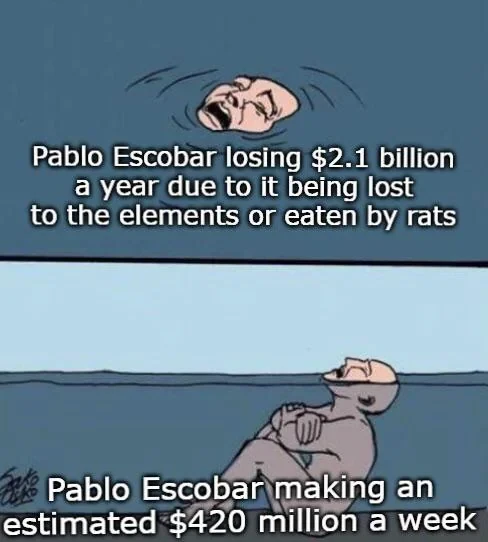
What’s “it”? His products? I couldn’t find the number in the wiki.
Edit: thank you guys! It didn’t occur to be that it’s actually the cash, that’s crazy!
In reality it was actual cash money. He couldn’t use banks due to his money being gained through illegal means. He had stacks of money just laying around so much he couldn’t really secure it. Columbia is generally warm and humid so a lot of pests like rats and insects. I heard he was spending around 10k a week just on rubber bands to wrap the money into stacks of a thousands.
If you don’t know he made most of his money by selling cocaine though.
Chap never heard of tupperware apparently.
Rats can chew through cement.
No way. Really? That can’t be much softer than their teeth.
Their teeth continually grow, and cement (not concrete) is not that hard to abrade away.
Yeah, sand definitely is much harder than teeth (which in a normal vertebrate are based on apatite, at a Mohs hardness of 5). If it’s abrasion, that explains a bit, although it’s going to be much slower than an actual cutting action. A quick search indicates cement is at Mohs 5-7, so you theoretically could chew through an unusually soft sample.
It absolutely abrades the teeth faster than the cement, but rats are very social creatures. The point is that the Tupperware doesn’t stand a chance against even a single rat.
You could also go with metal or stone, like an actual vault, but we both thought of tupperware. Go figure.
The District of Columbia isn’t that warm.
Maybe they meant the city from Bioshock Infinite. But I would think being at that elevation would make things colder, if anything.
columbia, missouri
Cash. His business was illegal (naturally), and it was the 1980s, so most of his profits were in literal cash that could not really be safely put in banks in the amounts he was bringing it in. So much of it was physically stored and hidden in various safehouses… and sometimes, vermin and the elements would get at it, destroying or rotting the paper money beyond usability.
was cash ever actual paper? I’m pretty sure the US dollar has been cotton since it was first created, only actual paper money i can think of would be proto-cash in the form of bonds and whatnot.
Cotton paper is still paper.
It being the literal cash.
No, his literal bank notes. Due to the nature of his business he hid his money wherever he could and a percentage of it was lost to environmental factors.
It looks like “it” is money, USD specifically judging by the $ in the meme.