Not the best example: Eastern-European countries tend to overcompensate and overdo the painting, making the result too noisy. Nordic cities look much better, precisely because they choose muted and coordinated colors, and usually paint the whole house instead of making patchy blobs. It so happens that khrushchyovkas are again better at it too, because they were built smaller and painted in one color, often muted orange or brown.
I did not say that I would consider those buildings in Petrzalka the height of all taste and beauty but the issue with it is not the colour of the buildings. It is the urban layout on ground level and the rundown horrendously car centric design. That is really dragging the area down. On the plus side, there is so much greenery even with all of that, that it is not looking grey there, certainly not during Spring-Autumn.
PS: Bratislava is west of Stockholm, has nothing to do with Orthodox Europe and Slovakia stopped being part of the East block almost as long ago as it was ever part of it.
It’s always funny how everyone between Germany and Russia say that they’re in Western Europe. Yeah keep telling that to yourself bud, Slovakia is certified Eastern Europe.
I am not Slovak, heck, I am not even with your expansive idea of “Eastern Europe” Eastern European.
I also did not say that Slovaks are Western European. Calling them “Eastern European” is as ridiculous as calling them “Western European”.
Tell me, is Dresden also Eastern European and how about Vienna?
What I wrote above: “Eastern-European countries tend to overcompensate and overdo the painting, making the result too noisy”. Just like in your above pic from Slovakia. But not in this one.
No need to inform me that some Western-European countries and even the US did housing of this style, as I’m perfectly aware that it was peddled by Le Corbusier at the same time as the USSR developed its approach, likely with cross-pollination at least in the west-east direction.
Also, Dresden will remain East-European in spirit until the former East Germany stop trying to recreate GDR with their conservative voting.
You misunderstand my argument. My argument was not that Western Europe also has commie block type neighbhourhoods, my argument was that you lack to point out what it is that turned a part of Europe into “Eastern Europe” that has little in common with Moscow and much more with Vienna, just because it was forced into a geopolitic block for roughly 40 years, until almost 40 years ago.
But then, you also appear to believe that Dresden is Eastern Europe, so at least you are consistent. Could it be that you are confusing “Eastern European” with “post communist”. Those two things are not the same.
Indeed I am. Because what I’m saying is that folks who got their aesthetic sense botched by decades of Soviet doctrine, don’t do well at dressing up the high-rises, even though buildings of a similar kind in the Nordics do splendidly.
And, as I mentioned in the thread, one can look at Stalinist housing and Khrushchevkas for examples of Soviet-type housing that didn’t need gaudy paint to look decent, because they were built at smaller sizes and with the last remainder of the sense of beauty. Russians also never bastardized the old districts in Moscow and SPb, because those had established aethetics (except for new buildings inserted here and there, which predictably look shitty for the most part).
People under 40 never really witnessed any Soviet doctrine anymore. They grew up in capitalism.
And if you are talking about commie blocks, like you said yourself, they exist in the West just as well. So do detached family home suburbs in post communist Europe btw.
PS: You are right though, Slovakia should do something about those paint schemes. They do look a bit gaudy.
I’ve been looking at post-Soviet architecture for decades, it’s still broken by the prolonged Soviet rule with its central imperative. It’s generational trauma, and it will take two or three more generations to recover from it: the sense of visual taste of all these people, previously cultivated over centures, was effectively stomped out, and they need to acquire it anew, which takes time and effort. The deeper you go into Russia, the worse it gets, but the ripples are seen far and wide. I posted some examples here. That last pic you provided is like a little baby compared even to your original photo from Bratislava.
If you want to see some really bad shit, check out Luzhkov’s style and capitalist romanticism. Those are prime examples of the looks being dictated by people who have money but no taste, and this has been going on through the nineties-zeroes, having been barely attuned in the 2010s by some hints of attention to modern Western architecture. And low-rank officials on the ground, responsible for painting the buildings, are certainly much less likely to read ‘Architectural Digest’.
The bottom image is heavily tuned to have more vibrant colors. No place in real life has such strong hues. I’d suspect that place in real life looks very much like the above image
Could be, but it’s still not the patchy mess that Soviet blocks tend to be colored into. New builds in Russia are often painted those very strong hues that apparently no place has. It’s horrible.
Agreed, that looks pretty horrible. It’s more due to the lack of any color harmony than the strong hues. There are places with strong hues that look good imo, like Burano


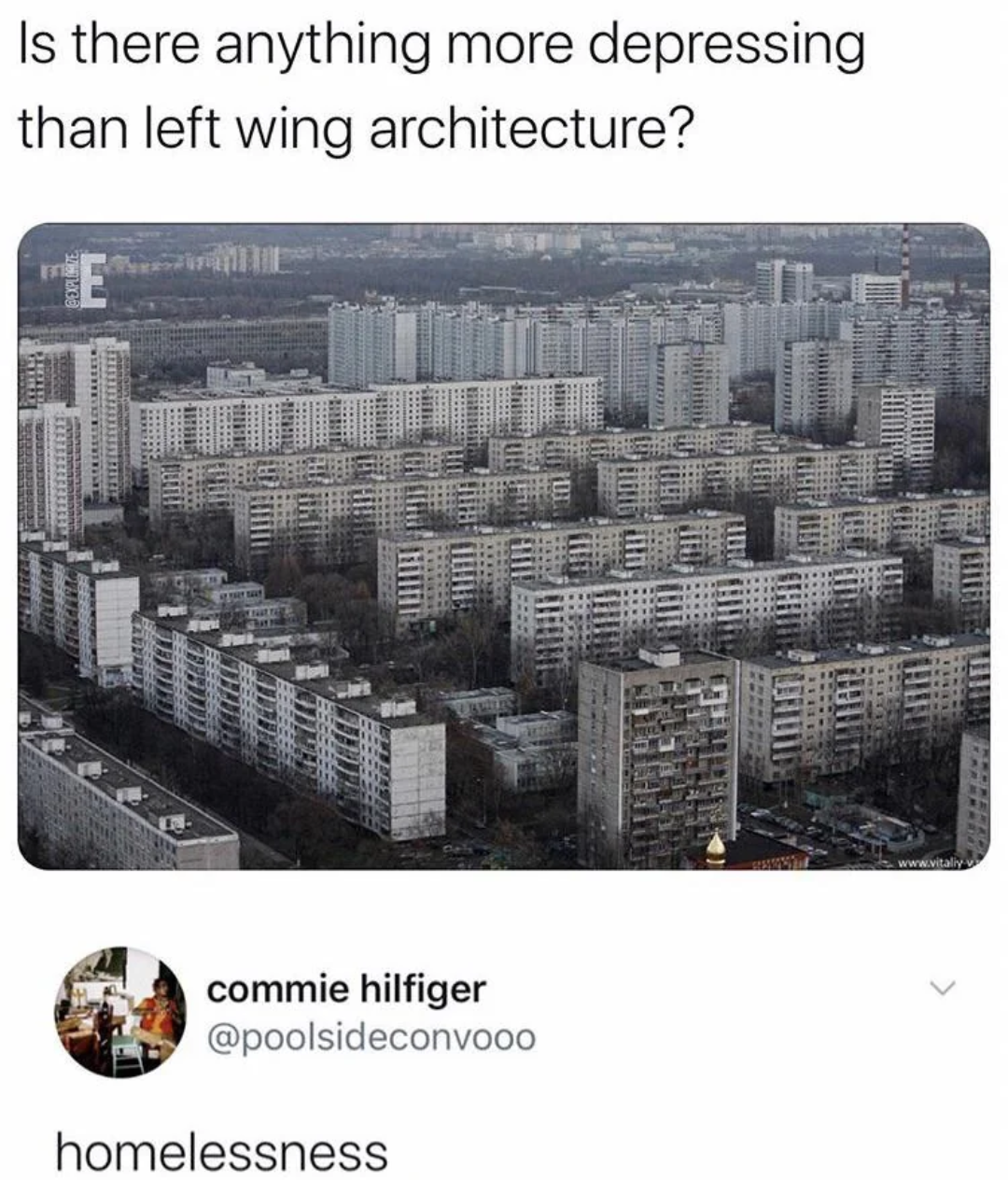
Not the best example: Eastern-European countries tend to overcompensate and overdo the painting, making the result too noisy. Nordic cities look much better, precisely because they choose muted and coordinated colors, and usually paint the whole house instead of making patchy blobs. It so happens that khrushchyovkas are again better at it too, because they were built smaller and painted in one color, often muted orange or brown.
I did not say that I would consider those buildings in Petrzalka the height of all taste and beauty but the issue with it is not the colour of the buildings. It is the urban layout on ground level and the rundown horrendously car centric design. That is really dragging the area down. On the plus side, there is so much greenery even with all of that, that it is not looking grey there, certainly not during Spring-Autumn.
PS: Bratislava is west of Stockholm, has nothing to do with Orthodox Europe and Slovakia stopped being part of the East block almost as long ago as it was ever part of it.
It’s always funny how everyone between Germany and Russia say that they’re in Western Europe. Yeah keep telling that to yourself bud, Slovakia is certified Eastern Europe.
I am not Slovak, heck, I am not even with your expansive idea of “Eastern Europe” Eastern European. I also did not say that Slovaks are Western European. Calling them “Eastern European” is as ridiculous as calling them “Western European”.
Tell me, is Dresden also Eastern European and how about Vienna?
Does that look like “Eastern Europe” to you?
What I wrote above: “Eastern-European countries tend to overcompensate and overdo the painting, making the result too noisy”. Just like in your above pic from Slovakia. But not in this one.
No need to inform me that some Western-European countries and even the US did housing of this style, as I’m perfectly aware that it was peddled by Le Corbusier at the same time as the USSR developed its approach, likely with cross-pollination at least in the west-east direction.
Also, Dresden will remain East-European in spirit until the former East Germany stop trying to recreate GDR with their conservative voting.
You misunderstand my argument. My argument was not that Western Europe also has commie block type neighbhourhoods, my argument was that you lack to point out what it is that turned a part of Europe into “Eastern Europe” that has little in common with Moscow and much more with Vienna, just because it was forced into a geopolitic block for roughly 40 years, until almost 40 years ago.
But then, you also appear to believe that Dresden is Eastern Europe, so at least you are consistent. Could it be that you are confusing “Eastern European” with “post communist”. Those two things are not the same.
Indeed I am. Because what I’m saying is that folks who got their aesthetic sense botched by decades of Soviet doctrine, don’t do well at dressing up the high-rises, even though buildings of a similar kind in the Nordics do splendidly.
And, as I mentioned in the thread, one can look at Stalinist housing and Khrushchevkas for examples of Soviet-type housing that didn’t need gaudy paint to look decent, because they were built at smaller sizes and with the last remainder of the sense of beauty. Russians also never bastardized the old districts in Moscow and SPb, because those had established aethetics (except for new buildings inserted here and there, which predictably look shitty for the most part).
People under 40 never really witnessed any Soviet doctrine anymore. They grew up in capitalism. And if you are talking about commie blocks, like you said yourself, they exist in the West just as well. So do detached family home suburbs in post communist Europe btw.
PS: You are right though, Slovakia should do something about those paint schemes. They do look a bit gaudy.
I’ve been looking at post-Soviet architecture for decades, it’s still broken by the prolonged Soviet rule with its central imperative. It’s generational trauma, and it will take two or three more generations to recover from it: the sense of visual taste of all these people, previously cultivated over centures, was effectively stomped out, and they need to acquire it anew, which takes time and effort. The deeper you go into Russia, the worse it gets, but the ripples are seen far and wide. I posted some examples here. That last pic you provided is like a little baby compared even to your original photo from Bratislava.
If you want to see some really bad shit, check out Luzhkov’s style and capitalist romanticism. Those are prime examples of the looks being dictated by people who have money but no taste, and this has been going on through the nineties-zeroes, having been barely attuned in the 2010s by some hints of attention to modern Western architecture. And low-rank officials on the ground, responsible for painting the buildings, are certainly much less likely to read ‘Architectural Digest’.
The bottom image is heavily tuned to have more vibrant colors. No place in real life has such strong hues. I’d suspect that place in real life looks very much like the above image
Could be, but it’s still not the patchy mess that Soviet blocks tend to be colored into. New builds in Russia are often painted those very strong hues that apparently no place has. It’s horrible.
Agreed, that looks pretty horrible. It’s more due to the lack of any color harmony than the strong hues. There are places with strong hues that look good imo, like Burano