So they elected the tories instead who proceeded to also do nothing which resulted in him getting back into power. Canada has been stuck between liberals and tories for a long time.
So they elected the tories instead who proceeded to also do nothing which resulted in him getting back into power.
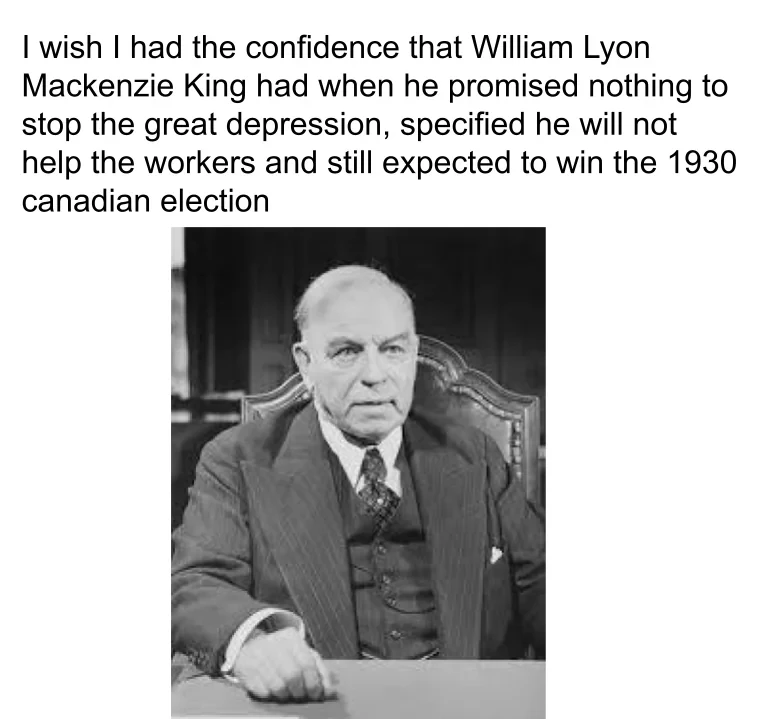
the prime minister of Canada for three non-consecutive terms from 1921 to 1926, 1926 to 1930, and 1935 to 1948. A Liberal, he was the dominant politician in Canada from the early 1920s to the late 1940s.[a] With a total of 21 years and 154 days in office, he remains the longest-serving prime minister in Canadian history.
Canada opted for harm reduction by choosing indolence over cruelty, that day. If the choice is all but binary, the choosing becomes simpler if no easier at all.
To a degree for sure. When it comes to general rural vs Urban there hasn’t really been the switch that the US had. And the broad strokes as to how those coalitions screw people because they focus on the monied interests of their respective constituents hasn’t changed. And that’s what played out here, where the tories ended up trying to adopt more progressive policies to support their rural base and got abandoned because of it. The liberals just never tried and absorbed that reactionary status quo in 35. It was pressure from the NDP that really forced the liberals to change their spots. Pierre Trudeau leaving the NDP for the liberals due to their inability to “win elections” says a lot more about the effectiveness of the election system at describing the will of the electorate than anything else.
Was it a switch in the US? I get the impression whole rural and urban areas tended to vote together more in the early 20th century, since it was more about race/ethnicity, religion and (in a way distinct from today) class.
On this side of WWII the existence of strong third parties is a striking difference in Canada, for sure. I’m actually not sure how British Empire things were in the 30’s, but if you go back any further that dimension appears as well.
The Democrat-Republican party was agrarian and anti federal. After the federal party collapsed there was a split with the agrarian Democrats and the more federalist types joining the whigs which became the Republicans. Democrats stayed largely agrarian/extractive until Roosevelt and particularly Truman realigned them to support more metropol interests. The republicans meanwhile largely supported centralized authority which has always favored the metropol until that switch. Now there’s no Rockefeller Republicans left. That’s why the American midwest is Republican. The southern strategy and race is a very important key, but land density usage is something you will see is not American specific in how these power coalitions form.

So they elected the tories instead who proceeded to also do nothing which resulted in him getting back into power. Canada has been stuck between liberals and tories for a long time.
https://en.wikipedia.org/wiki/William_Lyon_Mackenzie_King
Holy fuck, the meme made it seem like he was some losing footnote in history
Yeah they fucking demolished the tories in the 35 election.
Canada opted for harm reduction by choosing indolence over cruelty, that day. If the choice is all but binary, the choosing becomes simpler if no easier at all.
Edit: wrong reply
I mean, what those two terms mean has shifted around a whole bunch over time. Same as the US two-party system.
To a degree for sure. When it comes to general rural vs Urban there hasn’t really been the switch that the US had. And the broad strokes as to how those coalitions screw people because they focus on the monied interests of their respective constituents hasn’t changed. And that’s what played out here, where the tories ended up trying to adopt more progressive policies to support their rural base and got abandoned because of it. The liberals just never tried and absorbed that reactionary status quo in 35. It was pressure from the NDP that really forced the liberals to change their spots. Pierre Trudeau leaving the NDP for the liberals due to their inability to “win elections” says a lot more about the effectiveness of the election system at describing the will of the electorate than anything else.
Was it a switch in the US? I get the impression whole rural and urban areas tended to vote together more in the early 20th century, since it was more about race/ethnicity, religion and (in a way distinct from today) class.
On this side of WWII the existence of strong third parties is a striking difference in Canada, for sure. I’m actually not sure how British Empire things were in the 30’s, but if you go back any further that dimension appears as well.
The Democrat-Republican party was agrarian and anti federal. After the federal party collapsed there was a split with the agrarian Democrats and the more federalist types joining the whigs which became the Republicans. Democrats stayed largely agrarian/extractive until Roosevelt and particularly Truman realigned them to support more metropol interests. The republicans meanwhile largely supported centralized authority which has always favored the metropol until that switch. Now there’s no Rockefeller Republicans left. That’s why the American midwest is Republican. The southern strategy and race is a very important key, but land density usage is something you will see is not American specific in how these power coalitions form.