- 1 Post
- 43 Comments


Genocide.
Ecocide.
Domicide.
All of the above.
Take your pick
https://www.congress.gov/crs_external_products/R/PDF/R45098/R45098.5.pdf
Yep, nothing to see here
And no police have EVER been known to use LRAD or other similar devices /s
You can buy a laser that blinds faster than the human neurons can signal “blink” on ebay for less than the cost of a takeout meal.
Anything over 5mW (Milliwatt - 0.005 Watt) can burn out retinas in less than a quarter of a second.
The west also has directed energy weapons (IR Lasers and whatever the f**k they used in Venezuela that made the guards bleed from every orifice) formally used for burning missiles in flight, that can easily punch a hole through a human
Things like Acesulfame K, Aspartame, Steviol/Stevia extracts, I called them chemical sweeteners where it would be more accurate to call them artifical sweeteners.
It’s entirely anecdotal, but all of these leave a horrendous taste that overpowers the intended flavours in my opinion.
Sucralose is probably the only one that works as intended (massive sweetness to replace sugars at a fraction of the volume)

Flavoured hydration powders are a solid option, as long as you’re avoiding chemical sweeteners.
The trick is to make them at half the recommended strength by putting the recommended amount into double the volume of water, which will also stop you from giving yourself kidney stones by overloading you with minerals

 1·3 days ago
“Palestine did not exist before the 1930s”
1917 In November (October on the Julian calendar), the Bolsheviks seize power and Russia makes preparations to withdraw from the war. That same month, Britain issues the Balfour Declaration. In December, the British Army led by General Allenby marches victoriously into Jerusalem. Palestine is placed under British military occupation (1917–20). It then had a population of 688,957 Arabs (including Christians, Muslims and other non-Jewish minorities) and a population of 58,728 Jews.
1922 The Council of the League of Nations agrees to the text of the British Mandate of Palestine. The Palestine Order-in-Council of 1 September separates Palestine from the Emirate of Transjordan, which is established to the east of the River Jordan. The Colonial Secretary, Winston Churchill, in a statement on British policy rejects the claim that Palestine was to become ‘as Jewish as England is English’. He declares: ‘His Majesty’s Government regard any such expectation as impracticable and have no such aim in view.’ He adds that: ‘the status of all citizens of Palestine in the eye of the law shall be Palestinian, and it has never been intended that they, or any section of them, should possess any other juridical status. In an exchange of correspondence with the Palestine Arab delegation, Churchill recognizes ‘the people of Palestine’, specifically referring to Palestine’s Arab community.
1948 Civil war breaks out on a wider scale in Palestine. In March, the US concludes that partition is unworkable and reverses its policy. It declares itself in favor of a UN Trusteeship for Palestine in a single unitary state. A UN Trusteeship Agreement is subsequently drafted. The Jewish Agency condemns it, goes on the offensive and avows to proclaim a Hebrew Republic on 16 May. In April, the Haganah (Jewish paramilitary), implements the Plan Dalet. Thirteen military operations follow, eight of which are beyond the boundaries set out for the Arab state in the UN Partition Plan. On 11 April, a massacre is perpetrated by the Irgun with the support of the Haganah in the Palestinian Arab village of Deir Yassin, near Jerusalem. By May, the Zionists have conquered Jaffa (which was supposed to be part of the Arab state as envisaged in the UN Partition Plan) and Haifa, causing their Arab populations to flee to secure ground. At midnight on 14/15 May the last British High Commissioner in Palestine terminates the Mandate and departs Haifa. The Yishuv concomitantly proclaims the establishment of the state of Israel. By this time, over 350,000 Palestinian Arabs have been evicted from their homes. The Arab Legion, commanded by British officers, enters Palestine on the pretext that it is defending the population of Palestine from further attacks by the Haganah and the Irgun (Zionist paramilitary). It is supported by troops from Lebanon, Syria, Egypt and Iraq. The fighting escalates. In July, the Haganah captures Lydda, Ramle and Nazareth expelling its Arab populations. By the time hostilities come to an end some 750,000 Palestinian Arabs and 17,000 Jews are displaced by the fighting. In December, the UN General Assembly passes a resolution providing that: ‘the refugees wishing to return to their homes and live at peace with their neighbors should be permitted to do so at the earliest practicable date, and that compensation should be paid for the property of those choosing not to return and for loss of or damage to property which, under principles of international law or in equity, should be made good by the Governments or authorities responsible.
 1·4 days ago
Oh I have absolutely zero faith in the government.
Despite saying heavily regulated I would interchange that with with ‘making them so prohibitively expensive that the only people that can buy them have military contracts’
I understand your proposal, but wholeheartedly reject it at its premise.
It involves giving land that is historically Palestinian, to countries that are not Palestine.
And why is it that they don’t have power?
Is it because a nuclear capable occupation holds them under what can only described as an apartheid system?
Given that they left the shuttle booster unpainted to save on weight, I doubt we’ll be able to launch anything with armour that can stop anything but the smallest shards from doing damage, we also already amrour everything to protect against the constant bombardment of space debris, where even a spec of dust can create a 2mm hole
https://www.esa.int/Space_Safety/Space_Debris/Hypervelocity_impacts_and_protecting_spacecraft

[WEAPON DETECTED: LETHAL FORCE PERMITTED]
Do you think they’ll ever let a civvie use one of these things?
They’ll be more heavily regulated than guns are (in non american countries)
No, fascist. It’s up to Palestine. The country that existed before the 1930s. The country where people of multiple religions, Muslim, Christian and Jewish peacefully lived together until Churchill and the brits decided (under pressure from political groups) to sell land they didn’t own to a group with no claim to it.
It’s not up to the people killing civilians, it’s not up to Europe, its not up to the US, it is and has always been Palestine.
So you agree that the state of israel is a murderous one, and your solution is to give them the land of the people they murder with impugnity and celebrate the deaths of with champagne?
I yearn for the day Kessler Syndrome finally locks us on this rock with the billionaires that have ruined this planet for personal gains.
Their hastily built escape rockets coming face to face with chunks of debris travelling at orbital velocity, would truly be poetic justice.
Heralding the beginning of an actual civilised society, one without the people that spend their lives manipulating world governments and public opinion through lobbying and mass media.
 71·4 days ago
Yes! Lets turn every bootstepper into a superspreader of every preventable disease going! Who needs artillery and AI guided bombs when every soldier is a disease vector
How about we give the Palestinians their homeland back, and israel can be remade in america, since so many of the settlers have american passports, if we’re giving away any random country’s land to capitulate to this genocidal state?
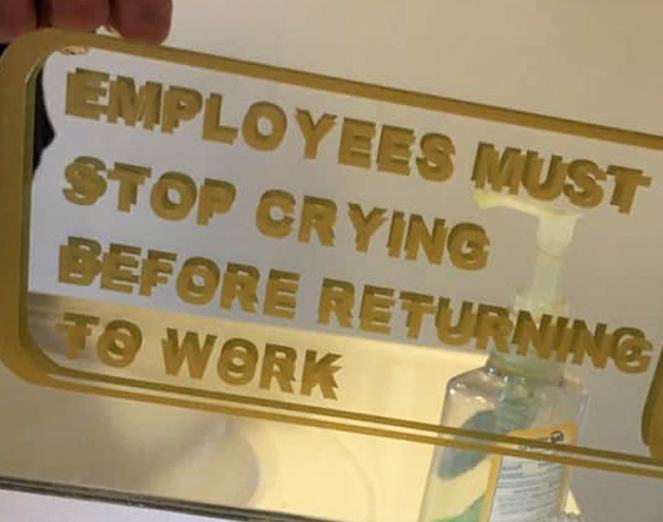

" How to keep yourself and five freinds occupied at the dinner party and create a centrepiece that’ll leave your guests speechless "