###Electorate of Cologne represent!

(*throws another archbishop to the curb*)
You know you done fucked up when your city gets attacked and your citizens run out to join the attacking army
Napoleon. Yes, it’s a little oversimplified but that man really shaped Europe and Germany with it.
Napoleon the third to be specific. Bismarck helped. A little bit.
"France, under Emperor Napoleon III, viewed Prussia’s growing power with suspicion and sought to curb its influence.
The immediate catalyst for the Franco-Prussian War was the Ems Dispatch, a diplomatic communication edited by Bismarck to provoke French ire. The altered message made it seem as though the Prussian King Wilhelm I had insulted the French ambassador, leading to public outrage in France and a declaration of war on July 19, 1870."
"The Franco-Prussian War had profound consequences for both France and Germany, as well as for the broader European political landscape.
The most significant outcome of the war was the unification of Germany. On January 18, 1871, in the Hall of Mirrors at the Palace of Versailles, King Wilhelm I of Prussia was proclaimed Emperor of the German Empire. This unification shifted the balance of power in Europe, establishing Germany as a major continental power."
That’s not what OP meant. Napoleon I occupied the German states and brought a lot of reforms including the abolition of feudalism, legal reforms, and administrative efficiency including centralized state governments. He completely reshaped German state borders. As an example, this article (in German) explains how 250 independent territories were merged into 3 territories (which nowadays are one state).
Which ironically kinda makes him a founding father in a weird way.
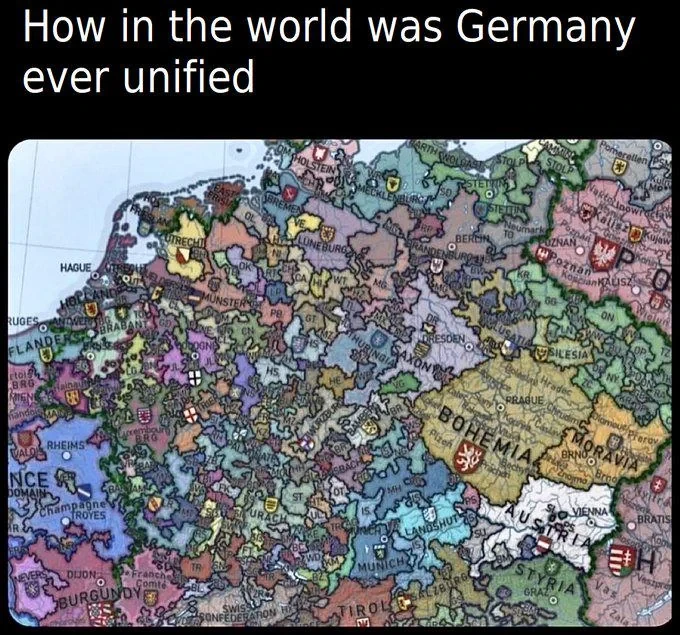
What’s also fun is that you often still encounter these boundaries today. Many of those splotches are now administrative districts: https://en.wikipedia.org/wiki/Districts_of_Germany
And up until 2023, you often couldn’t travel by bus across multiple splotches without getting multiple tickets from the different regional providers. It was awful.
It was awful.
It was glorious. All Hail to the Holy Roman Empire of German Nation.
/s
The Italians did it, it looked like fun.
Explanation: In the Medieval and Early Modern period, the area we now know as Germany was home to a… staggering variety of independent polities.
… it would take quite some time for them all to be sorted out and put under one flag.
Fighting the French did help a lot
Acshually briefly being governed by a certain french gentleman helped a lot more.
You’re right. Bonaparte is the common factor of every European country’s journey to unification, except the UK of course
Hatred of the French brings people together.
The enemy of my enemy is my friend.
The enemy of my enemy is the French. Even if my enemy is the French, then the enemy of them is probably Parisians.
That makes Parisians your friends. They have the SAME goal as you. They can HELP you.
Interacting with France is the gateway drug to country-hood.
Nothing quite like the mutual desire to not be french for making friends.
It usually does, no matter the context.
Why didn’t Bohemia, the largest polity, not simply eat the other polities?
Because reality is not Europa Universalis.
too busying creating the RHAPSODY?
We ate Moravia, the second largest, so there’s that.
Ostwald wasn’t born yet
Every country around them kept lumping them together as ‘those fuckers in the trees.’ Couldn’t even agree on a name for them.
sassage + musturd
Well, countries are all more or less delusions, yet made more or less real by the authority of states.
The real delusion in this story is that German is a language. From what I’ve heard, take three Germans from different regions, all speaking their mother tongue and they’ll have just as much trouble understanding each other as three Spaniards from diverse parts of Spain†. But while the Spaniards will be well aware that one of them is speaking Galician, one Castellan and another Catalonian, each German is convinced that he’s speaking German and that the others are speaking German in a weird way. Spaniards will likely speak Castellan, if not as their first then as their second language. Germans will all be familiar with a standard German but not really identify it as a distinct language from their own. Same story in Italy.
†: Assuming none of the Spaniards in the example are Basque.
It comes down to language structure and how similar they are. For example it’s easier for me to understand Dutch than Danish. Luxembourgish (recently recognized as separate language) to me is rural Hessian with some random French words thrown in - again easier than Dutch to me. For the German dialects you can use the same writing and it should be understood throughout Germany, Austria and most of Switzerland. Except for regionally used words like e.g. “leiwand” (Viennese for good/perfect). Another exception is if the writer is from Cologne - nobody understands their language.
As someone who understands Kölsch/Platt somewhat and usually speaks quite typical Standarddeutsch the rural bavarians as well as people with a very strong northern dialect are in casual speech almost as hard to understand as the dutch in Limburg.
germany has about 4-5 truly difficult dialects I’d say. (being an native speaker) I could understand every dialect after being immersed for a couple of hours except for bavarian tho 😅
there are a lot more local accents and dialects but Sächsisch, Pfälzerisch & Bayrisch are the ones that are really difficult to understand even for german natives from other areas. Hessisch partially as well. These are all bound to their local areas.
I’m speaking Hochdeutsch (“plain german” which should be the german y’all are learning in school) but there is also Plattdeutsch (spoken mostly in the north) which is it’s own language that is on it’s way to extinction.
ich bin mir auch ziemlich sicher, dass du kein platt oder allemannisch (aka “schweizerisch”) verstehst. Und ich behaupte mal, heute haben wir sehr viel weniger deutsche dialekte als noch vor 200 jahren.
Platt versteh ich tatsächlich zu nem gewissen Grad weil Verwandtschaft ausm hohen Norden. Allemannisch bzw Schweizerisch ist n deutscher Dialekt oder ne eigene Sprache? Ich kenn nur Schweizer-Deutsch als Begriff
& er hat noch nie nen Schwaben getroffen? Wenn er mit Hessisch schon Probleme hat?
haha hab ich wirklich noch nie und sorry falls du dich angegriffen gefühlt hast, mein einer Opa sprach hessisch mit polnischem Akzent und hat genuschelt, die Einschätzung beruht entsprechend auf persönlichen Erfahrungen (mit wenig Kontakt, hab den vielleicht 3x gesehen) 😆
hochdeutsch actually refers to the “higher altitude” dialects from the south like bavarian, saxon or swabian…
you actually mean standarddeutsch
https://en.wikipedia.org/wiki/Standard_German
Standard is a form of high german
Hochdeutsch refers to Standard High German, the “neutral” or “standard” dialect of the German countries. If you go to a village in Bayern and can’t understand them, it’s because they’re speaking Bayrisch instead of Hochdeutsch
No idea, if that’s a regional thing that “Hochdeutsch” primarily means Southern German to you, but here in South Germany, I doubt anyone would be aware of your definition and everyone understands “Hochdeutsch” to mean “Standard High German”.
My dictionary does list the Southern German meaning, but it’s listed as the secondary meaning.
well it’s what we call it here in the middle west of germany - hochdeutsch is the opposite to the dialects.
Source: I was born and raised here calling it “Hochdeutsch” lol
Hit the nail on the head.
Many german dialects are as you say, sometimes unintelligible with each other. However they are of the type where if you spend 1-2 weeks immersed in it you will very quickly start to understand it. Same thing happens in English. I heard an anecdote of someone who watched the Scottish series “Lemmy’s show” for the first time and could barely understand anything they were saying. But as they reached the end of the first season they had very little trouble. Intrigued I did the same and had the same experience (great show btw).
I’m not native speaker of German but I had such an experience. I learnt standard German in school as a foreign language. Last year I visited the Austrian family of my partner. The first day I could barely understand anything they were saying but after 2 weeks I could comprehend most of it. So where do we really draw the lines of a language? If you can comprehend it with less than one week of training is it really a language? I would say no. If yes then I would say some English dialects ought to be classified as languages (as I know some do, calling it the scots language).
The only reason why we have clear, hard borders in the modern world is because we have the tech to precisely measure distance and can talk about/handle them quickly/efficiently at a larger scale.
Holy Roman Empire, which was neither holy, roman or an empire(sort of).
At some point it included Rome, so at least that part is kind of true.
And it was also an empire
*Zooms in a Prague to see if I can see any KCD2 locations *
God be praised! Henry’s come to see us!
“By blood and iron.” I understand Bismarck after seeing that picture.
At the least, one understands the desperation of 19th century German nationalists in general. Border gore aside, imagine the tariffs and border controls one must go through for a simple day trip!
The previous emperor had rejected the 1848 attempt at unification from the Frankfurt National Assembly even though it planned on making him emperor of the Germans, because it was too progressive and he didn’t have enough control over it, so I’m not 100% sure blood and steel was the only option.
The same way Japan united.