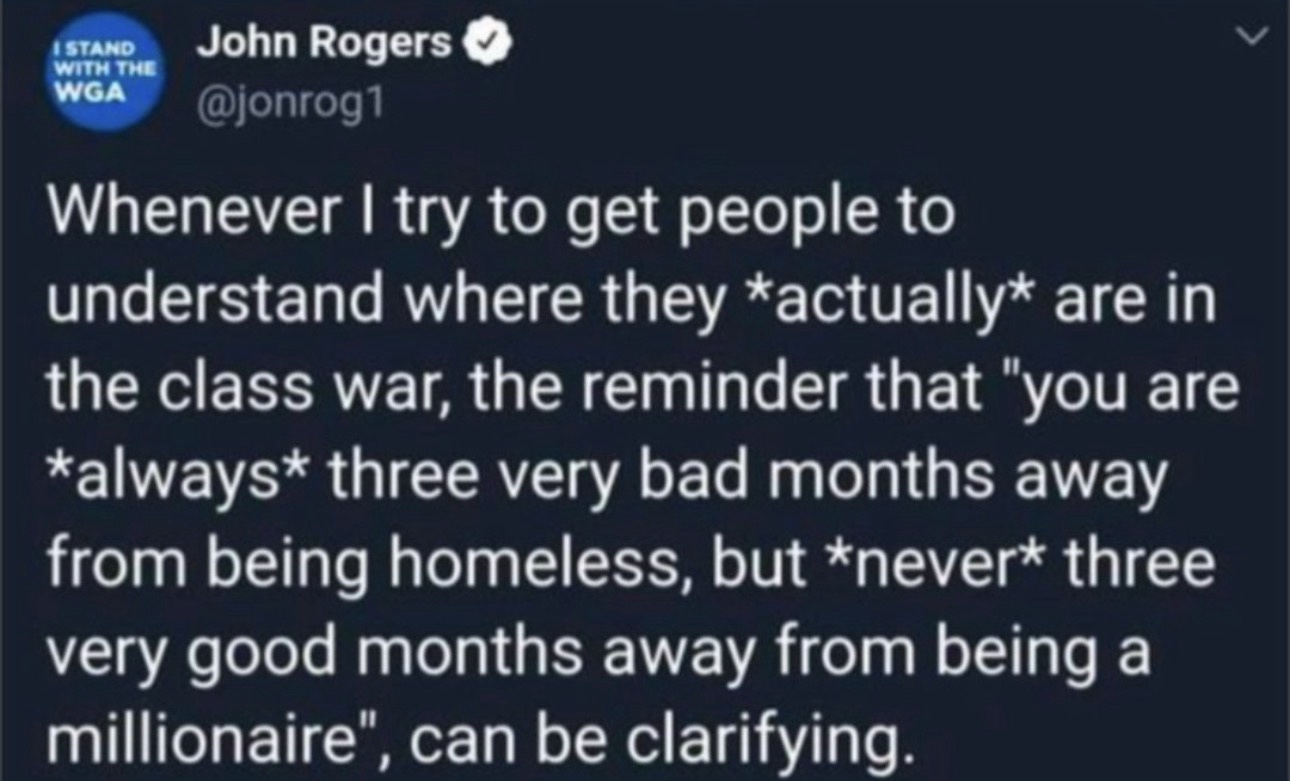
This won’t work on boomers. A lot of them have a property or two with a good amount of equity. My dad for example has a home with 700k+ equity and millions in investments. Granted he’s more responsible than most boomers and we weren’t wealthy during my childhood.
There are almost 24M millionaires in the US alone. A millionaire in 2026 honestly isn’t all that impressive anymore, thanks to inflation. I’m not saying we should feel sorry for them, just that it’s not the instant easy classification that it used to be.
As for billionaires, those should not exist, IMHO. A billionaire is a symptom of a broken economy, not a worthy goal.
Edit: fixed a typo.
Assuming we continue under neobliberalism, eventually those billionaires will become trillionares too.
Or a simple currency re-structure could turn those billionaires back into millionaires overnight without changing their relative wealth at all.
Focusing in the word “billionaire” was, in my opinion, a messaging mistake. I always preferred 1% because it scales, though 0.1% or 0.01% might be better.
I don’t love how we as a capitalist society have financialized everything into economic terms.
I’m rich now, but I grew up lower middle class (had food security and shelter security, but many aspects of middle class lifestyle were out of my family’s reach, like being able to dine at restaurants or go out of town for vacation or afford most of the things or experiences advertised on tv). I was also fairly financially insecure in college and the few years after (playing games with back dated checks to make rent or pay bills, lots of late fees and overdraft fees).
Even in those relatively insecure times, though, I was never anywhere close to 3 (or 6 or 12) months away from homelessness. I had a strong network of friends, family, neighbors, etc., who could keep me on my feet. Some of it was money (where people could chip in to help with an uninsured medical expense or loss to a car or a house), but a lot of it was social, like being able to get a ride from a friend when your car is in the shop, a meal train while someone is sick/hospitalized or bereaving the loss of a family member, etc.
By steering the discussion into purely what can be bought and sold with money in an economy between strangers, I feel like this misses out on what actually makes us secure, and what keeps us from homelessness and food insecurity. Those parts of society should also be protected and bolstered, even if they don’t fit cleanly into financial, economic, political, or policy categories.
It also misses who among us are actually the most vulnerable or the most secure. There may be people who have solid net worths on paper but aren’t actually resilient against bad months, and other people who might not look like they have much property/wealth/income but actually can manage a crisis just fine.
If your target audience consists of people who already agree with the basic economic principle, then by all means, add as much nuance as you like.
If your target audience is a single, white, cis male, 55k per year salary-making, apartment-renting, roommate-having, college dropout normie, then maybe a simpler distinction will be more effective?
That second paragraph of distinction is more clear
Depends on what the purpose is. In this thread we have people who very legitimately feel that despite literally being closer to millionaires than homeless on this “three months” test, they don’t feel financially secure. That feeling matters, and we shouldn’t ignore it.
And my point is that implicitly conceding ground by framing things in the language of emotionless finance and economics may actually be fighting things on less friendly territory to begin with.
implicitly conceding ground by framing things in the language of emotionless finance and economics
Your mileage may vary, but I do not consider this a concession. Anyone can make an emotional argument. You usually need to actually be right in order to make an emotionless academic argument.
may actually be fighting things on less friendly territory to begin with.
When it comes to arguing for the claim being discussed… whether you’re closer to homelessness or being a millionaire (the three month thing is incidental to the main point)… then whether these disciplines are friendly territory pretty much boils down to whether you can explain it or not.
Your mileage may vary, but I do not consider this a concession. Anyone can make an emotional argument.
No, I’m not making an emotional argument. I’m arguing that the subjective feeling of financial security specifically traces to certain hard-to-measure factors that aren’t easily reduced to quantitative metrics.
That’s why many people will look at the argument and say “oh I’m actually not that close to homelessness” or even “I’m basically a millionaire but I don’t feel like one.”
By highlighting the easy-to-measure metrics (net worth of a million dollars, not having a legal right to occupy a residence), it steers the discussion into the quantitatively easy metrics rather than the lived reality of people in the economy, which depends on other less quantitative factors. And then we’re talking about “winning” an argument that no longer cleanly maps onto what actually matters.
No, I’m not making an emotional argument.
Perhaps not, but you indicated that the “emotionless language of finance and economics” constitues “conceding ground”.
If you’re not making an emotional argument, then why would emotionless language be a problem? If we have no intention of making emotional arguments, why would we be conceding ground by focusing on “emotionless” disciplines?
And then we’re talking about “winning” an argument that no longer cleanly maps onto what actually matters.
I entered this conversation by specifying a target audience. In the same capacity, “winning” depends on who you’re talking to, as does the mappability of the argument onto real life.
If someone already agrees with the same basic principles you do, you can just talk, and they’ll believe you, because people aren’t skeptical of people they agree with.
But I’m not always having a discussion with someone who shares most of my fundamental beliefs. That’s simply not a situation where nuance matters. Just getting them to understand a single basic principle that they disagree with is already hard enough.
Perhaps not, but you indicated that the “emotionless language of finance and economics” constitues “conceding ground”.
If you’re not making an emotional argument, then why would emotionless language be a problem?
I think it is reductive to ignore/deemphasize the factors that cannot easily be quantified, in favor of only talking about the quantifiable factors. The subjective feeling of the people involved is backed by real factors, albeit factors that are difficult to quantify.
So shifting the discussion towards that rigid quantitative numbers is shifting away from where the conversation should be. That’s been my point this whole thread.
Being “a millionaire” is outdated. There are plenty of people who are both millionaires and working class. Because the US doesn’t do pensions anymore, people have to invest in 401(k)s and the like. It’s pretty likely that someone can hit $1m through a combination of a retirement fund and a house, but still be working class. In fact, you can be a millionaire on paper but still be vulnerable to homelessness, especially if you’re at an age where you can no longer work.
It’s certainly possible to retire on $1m, but it’s not going to be a lavish lifestyle if you’re playing it safe with your retirement fund. If you want to live near family, or if you have any medical issues, or if you might need to support someone else, it might really be impossible to retire with only $1m.
Agreed. I’m actually pretty close to being a millionaire “on paper,” since my house is worth $600k and I’ve got about $100k in retirement. But the house is mortgaged, and I can’t touch the retirement for another 25 years. If I had three very good months, I could probably just barely become a millionaire. But if I had three moderately bad months, I would likely default on my mortgage.
Replace the "m"s with "b"s in the OP, and this is spot on.
Edit: no, not “bonths.” Y’all know what I mean.
That’s not how net worth works…
If you have a mortgage, that offsets it and your net worth would only include the equity you hold.
Rich people do that sort of funny math all the time when stating their wealth, though. It’s all fake and made up.
If your $600k house isn’t paid off yet, you don’t get to count its full value towards your net worth, so you might not be as close to $1m as you say. If it is fully paid off, then you shouldn’t have a mortgage to worry about.
But, 3 really bad months could mean a tree fell on your fully paid-off house. It could mean a family member without good health insurance has a medical emergency and you feel like you have to help pay.
It just seems to me that something like $10m makes John Rogers’ point much better. If this is a class war, $1 million dollar millionaires really are in the same class as anybody else who works. I don’t know quite where the dividing line is. Clearly billionaires are in a whole different class. Same with $100m-aires. $10m is almost certainly set for life. What about $3m? $2m? Maybe age comes into it. How long do you have to make it last, and can you still find a job if you need one? $1m net worth at 25 is different from $1m at 65. $1m at 90 probably puts you back in the “set for life” camp, just because “life” is not likely to last much longer.
Yeah, we poor folks would have to do that, but rich people live on fractional reserve income and stuff, and they never subtract their liabilities from their assets when reporting their wealth. I’m okay with fudging the numbers for the point.
Definitely agree that $10m is the new bar for this.
If your house is mortgaged, you would have to subtract that mortgage from the calculation, would you not?
Rich people ignore their debt when making their wealth calculations all the time. I’m just following suit.
Being hobeless?
Oof, allergy season, eh? I get it.
Hobosexual, when you partner up for the housing situation rather than for romance/love.
That’s a fantastic word. I’ll take that, thank you.
A millionaire is still never have to work again money. Its not life of luxury never working again, but its easily a comfortable life of never working again. £500k or so is probably roughly the starting point of never work again but living very frugally.
The fact you’re using pounds instead of dollars says you’re probably talking about having 1 million pounds and living in the UK rather than the US.
1 million pounds is still a lot more than 1 million dollars, despite Brexit. In addition, if you live in the UK you’re covered by the NHS so none of your million has to go towards health care / health insurance. The cost of living is also lower in the UK than the US. So, as long as you don’t try to live in London you can get by with a lot less money.
The point is, John Rogers was trying to draw a distinction between two extremes. On one end you’re homeless and extremely desperate. On the other end, you’re a millionaire and are set for life. At this point, $1m USD in the USA really isn’t “set for life” anymore. Someone hitting age 65 with no pension and a total net worth of $1m is really still in the same “class” as the people who work 9-5 every day. They shop in the same stores, have to budget very carefully, worry about the price of gas, etc.
Rule of thumb for a retirement portfolio is to withdraw 4% per year. 4% of $1M is $40k. People survive on 40k/year, but you’d be considered pretty low income in most areas.
Big point being that in the US we have many cost of living expenses that the UK does not (or rather, you get it via your taxes)
A good concept to pass around is contrived desperation or manufactured desperation. The notion that desperation circumstances like the affordability crisis are intentionally developed by the ownership class so that workers will accept low wages, poor benefits, harsh conditions and abuse by their management and colleagues.
An extreme fictional example is in the TV series Squid Game. The players quit in the opening episode after they learn that the stakes of the game are their own lives, and only one final player would survive. But then (in the second ep) they return to their prior lives in which their financial situation is so dire, it compels them to return to the game.
The Epstein child sex ring is a strong non-fictional example of contrived desperation. The girls under Epstein’s employ quickly learned they were being groomed to be sexually exploited. But they were drawn from communities that offered few opportunities.¹ Girls quickly learned that they could escape their dire circumstances at home so long as they agreed to play ball, and be complicit in their own sexual exploitation.
We’re seeing another example in the US armed forces. All branches are achieving their recruitment quotas. Despite the news of the dire circumstances of the Abraham Lincoln. Despite that the military is deployed in an active theater. Despite that rates of abuse of enlisteds, especially of women, has only escalated since Hegseth’s tenure as SoD and his warrior ethos. Despite that the US is considering putting boots on the ground in Iran and Cuba.
And that’s because a growing number of people are finding they have no other opportunities to stay above water. People are going into credit-card debt and skipping meals, and working 40+ hours a week. They are three very bad months away from being homeless already, and their numbers are growing.
When the ownership class is sufficiently removed from the working class, it loses touch, and stops empathizing, and then starts contriving desperation to get workers to stay in their place. Unions can be an effective countermeasure, though they are often busted by the political class and the police.
¹ Epstein’s early victims were girls from post-Soviet Russia. During the collapse, the most popular career for young women was wage prostitute and children in the streets offering sexual favors for money were commonplace. It was an entire failing nation of desperate teenage girls.
That’s a lot of words, and in Idiocracy, they have a word to use.
I appreciate this well-articulated argument, though.
I honestly think the poor understanding of math is to blame for a lot of our problems. People don’t understand exactly how massive a billion dollars are, they don’t understand probability so they play the lottery. Most people get visibily angry when I’ve explained exactly how much money the Epstein class is hoarding.
If you counted 1 second every second until you reached 1 million it would be something like 11 days… if you kept counting like that until you reached 1 billion it would take you something like 32 years. If you were to CONTINUE COUNTING like that until you reached 1 trillion, over 31,500 years would have passed. Nobody needs a Trillion dollars. Hell nobody needs a billion. To defend billionaires is to defend the dragon pillaging your cities.
Polymarket and crypto have some people believing they’re only three days from being a millionaire
If the lottery is a tax on people who are bad at math, polymarket is the lottery for people who are bad at economics. Crypto is a religion for people who are bad at tech.
I mean it’s true for Polymarket, you could just place a bet on a local forest catching fire and then light it.
Edit to be super clear that I’m not condoning this behavior, just pointing out one single instance of how fucked up sites like Polymarket and Kalshi actually are.
There’s been investigations into people doing stuff like this, and they do not get paid out. Like the guy who bet there would be a streaker at the Superbowl, and then streaked at the Superbowl.
Yeah, and I’m sure Elon makes nothing off of the daily bet on the number of times he’ll tweet, too.
Millionaires are working class. $1B - $1M is ~$1B.
$1M ≈ 2 average single family homes
$1B ≈ 2000 average single family homes
Seriously. My partner and I are millionaires. We’re almost 40 and have a net worth just shy of $2M. We’ve a couple of DINKS. We’re both engineers, are pretty good with numbers, and understand compound interest. We got on the property ladder pretty early. I bought my first townhouse in 2012 pretty much right at the bottom of the housing market. We’ve moved twice since then and have benefited from the full rise in house prices.
Our net worth is a little under $2M. About $10k of that is checking and savings. Another $80k in a taxable brokerage account as an emergency fund. $450k in home equity. The rest is in retirement accounts such as 401ks and IRAs.
We are working class. The closest either of us have ever come to hiring someone is when we’ve hired a plumber or electrician to fix something at our home. I’ve technically owned a business, but just for my own freelance tutoring work. And the closest either of us have ever come to being a landlord was when I had a couple of roommates at that first townhouse I bought.
We’re doing very well; we have no complaints. And while we’ve achieved some modest amount of wealth, it’s not ultimately about living large or in luxury. We live well below our means. We recently bought our first new car in many years, a new Toyota Corolla. It replaced a 15 year old Corolla that my partner bought new. We buy affordable reliable vehicles and drive them til the wheels fall off. I still get most of my clothes at thrift stores. We have a house worth over $600k, but our mortgage payment is just $2k, and that’s on a 15-year note. A few years ago when I was in grad school, I was literally a millionaire who road the bus.
But again, we’re not trying to get rich for the sake of getting rich. We don’t want to own some huge company and lord over a room full of workers. We’re not trying to hoard the largest possible amount of money we can. We don’t view wealth as a lifetime high score. It’s simply a means to achieve stability and safety. We’re on the path to early retirement. We hope to retire by the time we’re 50. We need to save up a couple of million not because we want to live in luxury, but simply because it’s the only way to have a decent stable and safe retirement in this capitalist hellscape we live in. In a world with universal healthcare and a universal basic income, we would have no need for millions in retirement savings. If my partner and I each brought in say, $20k a year from UBI? If we had a paid off house and also didn’t have to worry about healthcare? We could live quite well off just that $40k per year.
I’m a millionaire and I support much higher taxes on millionaires. I do this because ultimately the point for us for having a couple of million is not to have a couple of million. The point is to have safety and stability in our lives. And the more secure the social safety net, the less the need to cover those needs privately.
You may not be rich by the common understand of the term and life style but you are not working class, you are part of the middle class unlike many Americans who say they are. It is a petit bourgeois class. If you have a net worth of almost 2 million dollars you own capital assets and by definition are not part of the working class.
Petit bourgeois? Our money is all in our house and in retirement assets that are just America’s poor excuse for a pension system. If we’re petit bourgeois, so is every retired school teacher that’s worked long enough to earn a pension.
Petit bourgeois refers to people that have to work but also control their own means of production. Classically this meant artisans, tradesmen, shop owners, etc. People who aren’t having their labor exploited, but also still have to work.
In our careers, we’ve almost always worked regular salary jobs. We’re not immune to job loss. We do not own the means of production. We’ve had our labor surplus siphoned off by employers our whole careers.
That’s the whole point of this discussion. Even most millionaires are just working class people trying to achieve a little bit of stability in their lives.
Owning the means of production is the capitalist and bourgeois class of which you are below and do the functional work for, the petit bourgeois are professionals like yourself. .8% of the world has a net worth over a million dollars and only around 2.5% of Americans have over a million in retirement accounts. You are quite literally in the global 1%
You are saying that capitalists own the means of production, while “little capitalists” don’t.
I don’t think its useful to lump in high-income professional work with the low end of capital accumulation. The sums may overlap, but the actual class interests don’t, at least not entirely. Good analysis should recognize the distinctions here.
You are quite literally in the global 1%
That’s true for a lot of people in “first world” countries. One is ahead of billions of poor people basically for existing.
Yeah, and none of them are in the working class. That wealth represents a direct transfer of wealth from where I live to the imperial core. You are all liberal petty bourgeois and you are not going to be allies in the revolution, you are going to side with your capitalists when you realize that breaking that transfer is going to be against your material interests.
You can have whatever definition you want. But for me, working class means just that - a person that has earned their bread through the work of their own hands, not through the exploitation of the labor of others, through rent-seeking, or from inheritance.
I’m sure you can cite plenty of theory, but frankly, I don’t care. I prefer a definition of the term centered in lived experience. If you go off raw wealth, you just end up classifying entire nations as working class or bourgeois, at which point the term loses all meaning.
Ok, except your wealth comes from a transfer of wealth from the labor and resources from where I live. Your wealth is based on the super exploitation of the rest of the world. You are enemies of the global working class and you’re not going to ever be revolutionary or do anything to change where you live because your material conditions are dependent on your empires continued exploitation of the rest of the world. At best people who live in the imperial core will use labor organization to secure themselves better welfare under the system you live in, you’re incapable of changing it because you are the perpetrators of it and your material conditions are dependent on it. This is why Americans are useless babies and why you live in a country that is run by someone like Donald Trump, he perfectly represents you. This is why “tankies” support literally any country that fights you, because you are the actual global villains in your banal servitude to the empire.
I think you’re thinking of the professional managerial class.
The PMC is part of the petit bourgeois in modern society. White Americans are for the most part not part of the working class or global proliteriat since their material conditions are based on the exploitation of the labor from where I live. Read Settlers
Can’t even buy a house for $1m where I live. So not rich.
Yeah, millionaire status is rapidly becoming meaningless. Lots of people who have a mortgage will probably be millionaires when they pay it off, but they can’t buy anything for it because they still need a roof over their head.
I think 10 million now is the million of the past. Call it inflation. It’s entirely driven by ridiculous housing prices (which are mysteriously not counted in inflation figures).
Put 5 randos in a room and one is a millionaire on paper.
It means nothing to be a millionaire if you include house car etc.
You can’t “spend” those items.
can with a heloc, but that’s just me being pedantic
I am old enough to remember when a simple savings account at the bank was 5% interest, no minimum balance. Now grabbing a high yield account of 3.5% is doing well for the average person, and requires a high balance to qualify for that “incredible” rate.
Yes but a mortgage was 11%.
Now housing was still affordable then, so…
Housing was affordable and wages hadn’t fully flatlined, so a single income family could still possibly pay that mortgage, even pay extra against the rate, and support a family. Definitely a lot more than one single rate number, lots of things are broken.
I would absolutely take the interest rates of the 1980s with the housing prices of the 1980s.
10 million
Decamillionair
Owning a house doesn’t protect you at all. Every decade or so there’s a real estate bubble that pops, you lose all your equity, and you have to start over.
Also try not paying your taxes, or your HOA, and you’ll quickly find out that you don’t really own your home, you’re still paying someone to keep it, or the court will forcibly remove you. And if a squatter moves in, they can stay, and you’re paying for the right for them to stay there.
That’s if you consider a house a store of wealth.
I consider it a place to live that compared to everything gets cheaper every year. By the time my mortgage is paid off all I have to pay is maintenance and property taxes. Which are a fraction of rent. If we assume things stay proportional, rent for a similar property per month is around $1,200. My property taxes are $2,800. Double that for a yearly average maintenance cost. That’s 466 a month. You can’t even get a used sedan for that much a month let alone a place to live
Also in 0 states can a squatter move in to an owner occupied home and claim squatters rights. Only an issue if the property is vacant
I was shocked to learn that the average homeowner in the US lives in their house for only 7 years. I think it’s due to the nature of how huge the country is and that something as simple as a job change means you have to move across the country and sell your house. There’s also the culture of always upgrading.
I grew up in a place where you usually buy once and live there forever, so equity isn’t really too important. But then again it’s a more centralized way of living where you can stay in place for most of your life.
I bought land with this mentality. Permanently reducing my costs and investing in off-grid infrastructure to make retirement cheaper.
I think it’s also the culture of seeing real estate as an investment. People buy houses planning on selling after they’ve lived there. I personally don’t think I can tolerate the risk of using equity as leverage for paid off land, because then there’s a risk the bank will take it. I’d rather leverage things I can live without if the bank takes it for whatever reason.
I was shocked to learn that the average homeowner in the US lives in their house for only 7 years.
I wonder how much of this is a question of what average is being used. It’s the old median vs mean problem.
Elon Musk and a hundred homeless people are in a room. By the mean, the average person in that room is a billionaire. By the median, the average person is homeless.
I’m really curious whether that 7 year average figure is based on the median or mean. Because I could see it being really skewed by young people in their twenties that move around a lot.
As with all things finance, depends on where. $1m in San Francisco means you can’t afford a home. $1m in Sicily is a great life.
Canada?
With 3 million dollars in liquid assets (ie: not a house), you can bring in about $120k from the safest of investments. Just a high yield savings account. Fully insured.
With an index fund, you can bring in $300k.
That’s enough to live on, given how many people live on that much or less from their job.
So some millionaires may work, but they’re not really the same.
But most “millionaires” are paper millionaires — they have a house and a car and a retirement fund and an emergency fund. Upper-middle-class, for sure, but they’re still working or retired from a lifetime of working.
That’s why I specified liquid, not-a-house, money.
Investment returns are by definition the fruits of other people’s labor.
And yet ultimately that’s what every retirement and disability system of any kind has to be based on. Whether you’re talking traditional methods of just letting your old or sick relatives live with you, state-run pension systems or disability, or private retirement accounts and disability insurance, it’s all ultimately the same deal. The systems vary extremely in their effectiveness and equity. But ultimately there’s no getting around the unavoidable truth. If you want to live in a world where the elderly and disabled are simply not abandoned to die, some of the labor of the young and healthy will be siphoned off to support the old and infirm.
If you want to live in a world where you yourself will not be cast out onto the street to die when you are too old to work, then for some of your later years you will depend on the labor of others, just as you did when you were a child.
And yet ultimately that’s what every retirement and disability system of any kind has to be based on.
There’s a fundamental distinction to be made to the below point of yours:
If you want to live in a world where you yourself will not be cast out onto the street to die when you are too old to work, then for some of your later years you will depend on the labor of others, just as you did when you were a child.
I strongly disagree with your first point, but maybe you misunderstood me. Investment returns are basically letting other people work for your profits, with nothing given in return. I.e. a form of wage theft (or other shenanigans like messing up the environment for profits or exploiting resources or funding a totalitarian regime).
Your second point - while correct - has nothing to do with my criticism of (stock / fund) investment returns: That could be (and was for a few decades, at least in Germany) a generational contract, where society manages to pay out pensions from which elderly / retired people can afford living & care from the GDP. Those pay-outs have been paid in advance by those needing them because they funded the old and retired people at the time they were still in work.
For that system, you do not need any kind of finance products. Of course that doesn’t keep our corrupt governments from spending our retirement money elsewhere and investing in shady funds for private profits and shitty retirement payments. So in today’s world, in practice, yes, people rely on finance product returns for their retirement savings and most of us have no choice in that. But it wasn’t always like that, and it should not be, because it’s a pyramid scheme.
That’s just retirement
I thought FDIC insurance capped at 250k/person
It’s per person per bank (or similar), so you can split deposits across multiple banks and stay FDIC insured over $250k.
As the other said, it’s not per person. Wealthfront and betterment insure up to like 500k, because they put the money in several banks. Vanguard probably has a similar thing.
I learned recently that FinTech companies like Wealthfront actually aren’t FDIC insured but like to claim they are because the banks they use behind the scenes are.
But there was one case where a similar FinTech company went belly up for whatever reason and their platform closed down, and customers couldn’t claim back their savings because apparently all the money from everyone was pooled into a single (or a couple) of accounts on each of the backend banks, and the banks had no idea how much was owned by who. I moved most of my money out of my Wealthfront HYSA after learning about that.
To see if your financial institution is directly insured, you can check here: https://banks.data.fdic.gov/bankfind-suite/bank
EDIT: Found an article: https://www.cnbc.com/2024/07/02/synapse-fintech-fdic-false-promise.html
Well that’s concerning. They say it’s all insured via the partner banks ( https://www.wealthfront.com/blog/wealthfront-fdic-insurance/ ) but you can just put anything on a website.
It’s technically true (“insured via”) but customers get into a false sense of security. We don’t know how they manage the money in their partner banks behind the scenes. If they operate like Yotta (in the linked article) did, then good luck getting your money back if Wealthfront suddenly closes. And the worst part is you can’t claim insurance with Wealthfront because they aren’t actually insured (the partner banks are) and they don’t actually have any of your money.
Of course I’m not claiming Wealthfront has the same setup. But I’d rather just deal directly with an FDIC-insured bank than have that uncertainty. Besides, Wealthfront’s rates aren’t any better than other banks right now anyway.
Yup. 3 million and my husband would not work at all. hed handle whatever he wanted and I’d work from home as I do now, maybe a less stressful job. A lot would be donated and given away to those in need.
For the vast majority of millionaires, their wealth is mostly home equity, not liquid funds.
Because of that whole exponential thing, millionaires and ten-millionaires are actually closer to the rest of us working class folk than they are their billionaire owner-class brethren.
And this is going to be important when the ultra-wealthy decide to reveal their less-rich near-peers aren’t actually in the oligarchs club, and don’t get to live in Thiel’s Rapture-style hypercities with the real people.
You know the difference between a millionaire and a billionaire? About one billion dollars.
But yeah, like the other commenter said: $10m puts you WELL outside of working class. That’s enough to retire on anywhere on the world, and with a high degree of luxury outside of a handful of the most expensive cities. That money, invested by anybody with half a brain, will make enough money per year than many extremely skilled professions make. We’re talking doctor salary without doing any actual work. They’re not buying senators wholesale like billionaires, but their house rep probably knows them by name.
That’s true, but if you have $10m, you can live off the “work” your money does for the rest of your life. If you have decent, conservative financial planning, you are in no danger of homelessness no matter how bad 3 months are.
Billionaires are today’s emperors, but someone with $10m is at least a member of the aristocracy and is living off the labour of others, rather than having to live off their own work.
Nuh-uh. I have an uncle who lives two doors down from a lady whose nail stylist’s daughter’s teacher just won 10 million dollars from a scratch off lottery ticket.
See how many draws it would take for you to win!
Congrats to that teacher, but random events with astronomically low odds don’t refute everyday reality. The vast majority of people are a lot closer to poverty than they’ll ever be to financial independence.
You can’t count on luck, and I expect that $10 million to evaporate in less than a year. It usually does.
All but $4 million of it evaporated before it actually hit her account. But also, this was hyperbole.
Well, I’M okay. I’m at least four bad months away from homeless so no sense planning to change the system any.
If I was in the USA, I’d be 6 months. But I live in Spain, so I’m 13 months but a whole lot less worried.
Well a million dollars isn’t that much anymore.
And no matter how good the facade, I will always reflect my white trash roots.
And now I cant really remember what the point is I was going to make. Damnit. I hate it when that happens.
Oh well, never mind.
Feels like being a millionaire now is what it takes to live without fear of incipient poverty
I don’t think even a million would do that anymore.
My brother’s dog ended up having Addison’s. The vet bill was about $10,000. It all happened so fast. He is a really beloved pet and my brothers best friend. How do you say to the Vet just kill him, I can’t afford it.
He did retire with a million. And has been living on it and SS. But the pile is diminishing quickly and both he and his wife have developed serious medical issues. And the car on its last legs.
And he looks at how many years the doctor gave him to live, then at the size of the bills, and the pile of the cash and the numbers just don’t work out.
And I know this means nothing to 30 something looking at a lifetime of Walmart wages. But with his health fading it still is scary.
But the pile is diminishing quickly and both he and his wife have developed serious medical issues. And the car on its last legs.
This sounds like the main problem is that his healthcare money is used to bomb Iran, and other misadventures. In the civilized world, we retire early if we are able and willing. If health issues come up, you don’t need to burn up your savings to survive.
Medical bills can eat a ton of savings. My plan is to die early and not tell my kids about said plan
I’m sorry about the dog, but that informs the level of lifestyle he and his wife have. A million dollars can last a lot longer if you live minimally versus comfortably.
And you would mistaken about "level of lifestyle’.
They are not country club set. They are in danger of dropping into poverty. They live in NJ and the tax burden and cost of living is very high. So much so i keep trying to convince them to leave, just because the numbers don’t work out. But their house is near all the hospitals and all their friends, but they really can’t afford to live there anymore.
It happens to a lot of seniors. They think they will live in their home forever, then the area gentrifies, taxes go up and inflation kicks in and they end up struggling.
No I’m pretty sure I’m right about their lifestyle. Your reply confirms it. People assume their level of wealth and comfort is the baseline. Being close to their friends and hospitals is their justification for inaction. You are right in trying to get them to move though. A million dollars goes a lot farther in Alabama than in New York.
Okay, you are obviously just a troll. I’m done here.
I’m not a troll. Just because you don’t like what I’m saying doesn’t discredit what I’ve said. You can be done though. Best of luck to your friends.
All the best doctors are in Alabama.
You’re almost getting it…
Sure, but many people who aren’t really grappling with where they are in class struggle will still see that and believe it makes intuitive sense because of some aggrieved entitlement. Lemmy is a great platform to find people who know some element of socialist or Marxist politics, but then think the problem is “oligarchs” who are just exceptionally naughty and greedy and not like, a system that produces food and fabrics for insanely cheap and specifically to their benefit.
Generally speaking, it doesn’t matter how many good months you have. You’re still 3 months out.
Very relatable perspective!