France has 348 taxes, the UK has 90, and Germany only 60. We map all three tax systems and explore what drives tax complexity - and what the UK can learn.
Tldr; France had barely any reforms, Germany had two big ones. Both Germany and France have a higher tax burden compared to the UK, amount of taxes ≠ amount paid in tax. The more taxes, the more complex the system. A complex system decreases international attractiveness for (large) businesses, so it would be good if UK looked more like Germany when it comes to taxes.
There is a bunch of charts in the article that might answer that question, but i honestly have no clue how they compare to each other. I wrote that based on what i read in the article:
[…]
France raises a lot of tax: €1,321bn, equal to 45.3% of GDP, compared to 37% in the UK. […]
[…]
Germany is different. It is not a low-tax country: in 2024 it raised €1,817bn, equal to 42.2% of GDP. […]
I may have overlooked it, but I did not see a single chart nor any mention in the text addressing the tax burden for an individual worker.
Which would be a far more meaningful discussion that the pure number of taxes.
It might be out of the scope of this article, since the main message is that a simple system is good for attracting large companies. Maybe they did not write about it because those companies don’t care, maybe it’s because the author or the people behind the website don’t care. But i suppose they have a reason. I surely would read about that


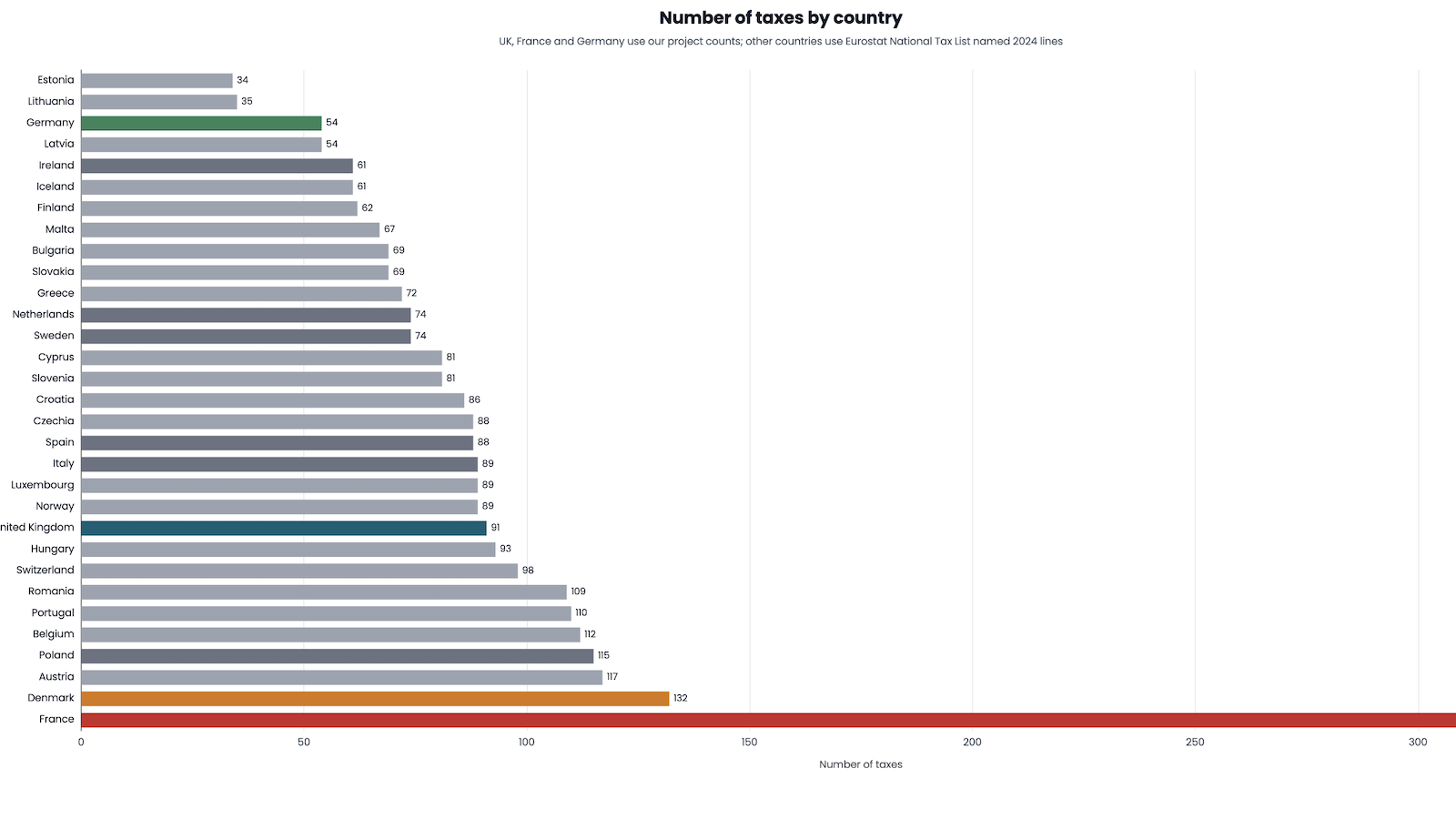
Tldr; France had barely any reforms, Germany had two big ones. Both Germany and France have a higher tax burden compared to the UK, amount of taxes ≠ amount paid in tax. The more taxes, the more complex the system. A complex system decreases international attractiveness for (large) businesses, so it would be good if UK looked more like Germany when it comes to taxes.
Doesn’t the UK have a higher tax burden on the proletariat (the wage labouring class)?
There is a bunch of charts in the article that might answer that question, but i honestly have no clue how they compare to each other. I wrote that based on what i read in the article:
I may have overlooked it, but I did not see a single chart nor any mention in the text addressing the tax burden for an individual worker.
Which would be a far more meaningful discussion that the pure number of taxes.
It might be out of the scope of this article, since the main message is that a simple system is good for attracting large companies. Maybe they did not write about it because those companies don’t care, maybe it’s because the author or the people behind the website don’t care. But i suppose they have a reason. I surely would read about that