

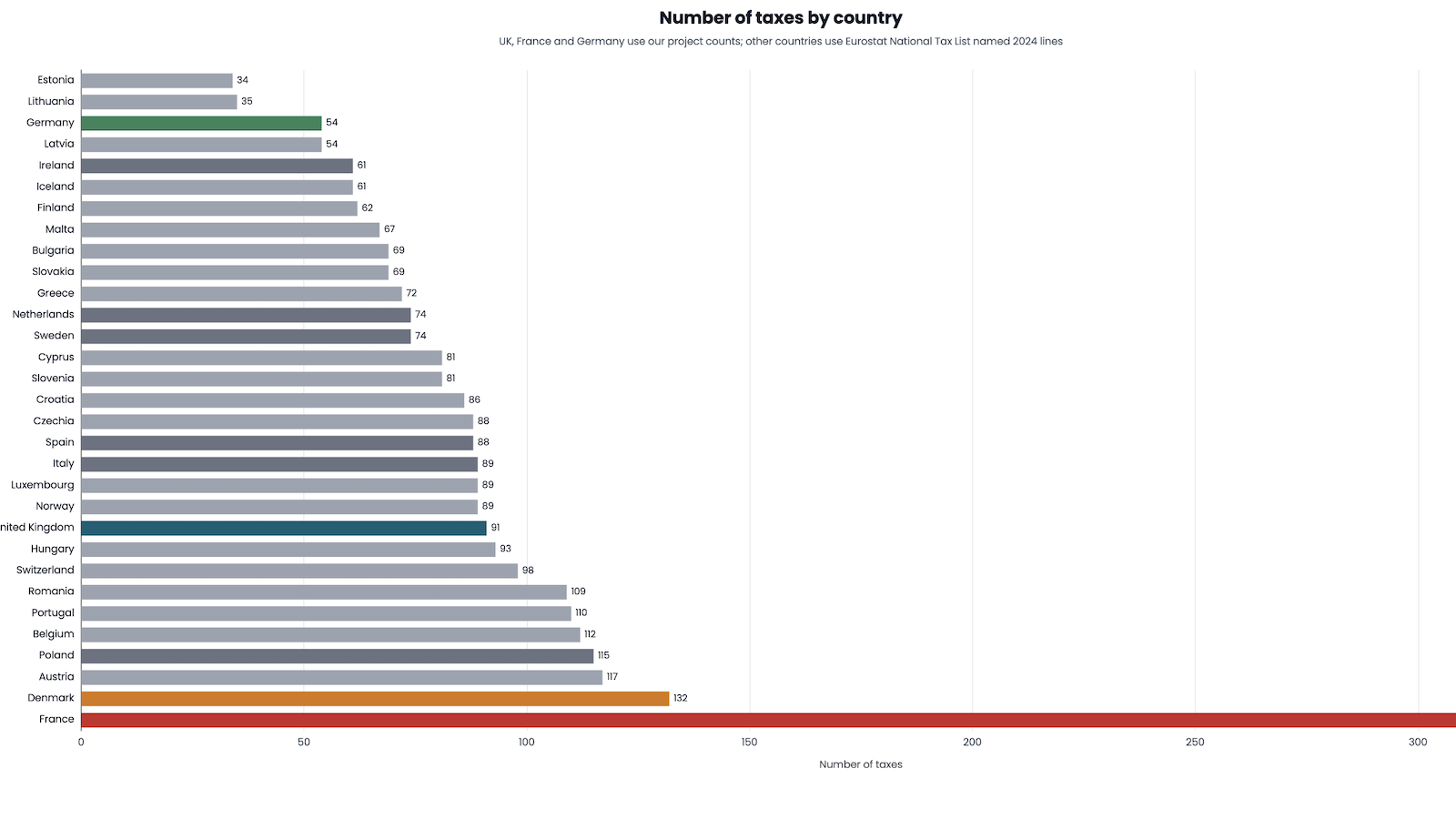
each tax means a new adviser
That is evidently untrue and I doubt they want to tell us that French companies need 300+ tax advisors. Yes, more taxes can mean more complexity. So do more laws, more employees, more customers or more product lines.
This is a completely pointless truism than does not prove anything.
They just claim that it’s bad without anything substantial to back it up.The statement that you can raise the same tax revenue with fewer taxes shows that they don’t understand why different taxes exist in the first place.
Also it conflates taxes, fees, social security contributions, all of which may follow different legal and budgetary rules.
“Number of taxes” is such a meaningless index it is impressive.
Tldr; France had barely any reforms, Germany had two big ones. Both Germany and France have a higher tax burden compared to the UK, amount of taxes ≠ amount paid in tax. The more taxes, the more complex the system. A complex system decreases international attractiveness for (large) businesses, so it would be good if UK looked more like Germany when it comes to taxes.
Doesn’t the UK have a higher tax burden on the proletariat (the wage labouring class)?
There is a bunch of charts in the article that might answer that question, but i honestly have no clue how they compare to each other. I wrote that based on what i read in the article:
[…]
France raises a lot of tax: €1,321bn, equal to 45.3% of GDP, compared to 37% in the UK. […]
[…]
Germany is different. It is not a low-tax country: in 2024 it raised €1,817bn, equal to 42.2% of GDP. […]
[…]
I may have overlooked it, but I did not see a single chart nor any mention in the text addressing the tax burden for an individual worker.
Which would be a far more meaningful discussion that the pure number of taxes.It might be out of the scope of this article, since the main message is that a simple system is good for attracting large companies. Maybe they did not write about it because those companies don’t care, maybe it’s because the author or the people behind the website don’t care. But i suppose they have a reason. I surely would read about that
What kind of framing is this? The number of taxes really doesn’t matter and it also makes sense for a country to have a lot of taxes in its books. Taxes can totally steer people into a desired direction and it makes sense for a country to have a lot of taxes. Not to finacne the government, but to make undesired stuff like cigarettes or alcohol. Maybe you could finance your country with VAT only, but that would also mean that cigarettes would be dirt cheap and that your citizens will die of cancer
From the article:
Does it matter?
We think it does. We usually focus on complexity within individual taxes, but “number of taxes” is also a sign of complexity. When you’re a company looking to do business, each tax means a new adviser, a new set of advice, and a new list of things you can and can’t do.
The article goes on, explaining the differences between two extremes withing the EU (France on the one end and Germany on the other). It’s not saying all taxes are bad, or a low tax burden is good - it is arguing why complex tax systems hurt business. I agree with you that expensive cigarettes increase the population their overall health, i have no reason to believe the author thinks different.
The point is that everyone who does any kind of business needs to be aware of the taxes that are important to that tiny corner of business. The more individual ones exist, the more complicated it gets and the easier it is for everyone in the system to make mistakes - and that includes tax offices. For example: Germany has at least five different taxes for alkohol and alcoholic drinks. They include a tax for beer, one for sparkling wine and one for mixtures made from soft drinks and alcoholic drinks. Now you need someone to classify each beverage by category and maybe a lawsuit or two to figure out exactly which is which.
That’s a perfect example:
- There is the general alcohol tax
- There is this sparkling drinks tax introduced to finance the Kaisers navy. Which really is stupid to have and maybe should be abolished
- There is the “Alcopop” tax which totally managed to kill this category of drinks as intended
So yeah, a little bit mixed. And i kind of disagree that this is too complicated. If you’re a supermarket or some kiosk, your supplier will provide you with the necessary information about the product. The Schaumweinsteuer, Biersteuer and Alcopop-Steuer are taxed directly at the producer level. Yes, you may need to deal with the beer tax when operation a brewery, but that really is not that complicated.
deleted by creator
Because governments love taxes from workers. Germany actually does love taking taxes from working class people, but obviously hates taking taxes from businesses and the rich people. Thats my perception as a german.
deleted by creator
because not all taxes are equal. High taxes for rich can lead to higher equality and a better wealth distribution.
Current taxes ,which focus on income instead of wealth, will burden workers higher.
Because it’s about taxes. Can’t talk about taxes without class nuance. They’re joined at the hip. I don’t know why you would feel it is out of context…
Political discussions & Lemmy. You’re likely to get a pretty skewed opinions here whether you asked them or not.
Because governments love taxes.
I mean, they’re talking about the number of different taxes rather than the total tax load.
Do they also love hospitals, roads, social services…?
But what have the Romans done for us lately?
