Maybe, but I don’t know if that’s a good thing. Social intelligence is how CEOs and other charlatans get disproportionate success in society, and if all we had was social intelligence humanity would be nothing but smooth-talking cavemen.
People often say that psychopaths act like they do because they don’t know how it makes people feel but the opposite is actually true - they know exactly how other people feel which is why they’re so good at manipulating them. They simply just don’t feel bad about taking advantage of that.
A thorough test made up of several tests can give a full scale IQ with component scores. Big gaps in the scores, like between verbal intelligence and working memory or processing speed, even helps us detect ADHD.
I feel like I need high processing speed more than anything else when playing competitive video games.
I think those thorough tests are (as you also suggested) mainly used as a diagnosis aid for conditions like ADHD which can manifest as discrepancies between the component scores. In neurotypical people the component scores are AFAIK generally strongly correlated (that is to say, basically the same).
Imo definitely common sense, which might not be a formal category of intelligence, but it follows from empathy, risk assessment, and understanding of consequences. Sociologists could probably do research to nail down an exact definition through and psychologists could probably measure it, though I suspect it would only really work intrademographically. What’s common sense for a rich, well spoken, fourteen year old white girl is different from common sense for a poor, uneducated sounding, twenty five year old black man, because they unfortunately face very different potential consequences for the same actions.
As a really rambling example (sorry!)
When I was the former in the US, I used to seek out and make conversation with cops if I was planning to buy or carrying (well sealed and odorless) weed at an event, because I figured they’d think I was less likely to do that if I was committing a crime, so they’d be less suspicious of me/give me more leniency if they caught me (because police corruption is a fractal: any amount of positive or negative interaction with them confers exactly that amount of forbearance or spite in future interactions). That’s terrible common sense for the latter demographic, but it worked very well for me and most of the white stoner girls I knew. Even the same demographic but older has different ideas of sensibleness. I would never seek out a cop like that today, because: A) I know that the real reason it used to work probably has more to do with us having been young teenage girls recognizing their authority than with us seeming more innocent (though the corruption bit was right), and wouldn’t apply to a woman as old as I am anymore*; and B) what works best for my current demographic is just blending in (or I guess getting way closer to a cop, but that’s both skin crawling and a much longer game than I am willing to play).
/* I’d argue it’s partial credit for common sense there and partially luck that my theory had positive consequences in common with reality, but this exemplifies the problem of letting each demographic decide for themselves what constitutes “common sense,” and use it as a metric for correct behavior /** (I’m sorry about the footnote within a footnote, my ADHD meds just kicked in on a day when I have nothing to do for the first time in over two months, after just finishing teaching a six week long German intensive course, teaching the same group for four hours every weekday, and the fediverse is the victim of my hyperfocus today).
Common sense might convince an adult not to trust the extremely rare sketchy-seeming but totally genuine opportunity, but it might also convince a teenager to trust the teacher or other adult entrusted with their safety who’s willing to buy them alcohol and nicotine products. However, if we allow people to weigh in for all of their younger demographic counterparts, we would risk making common sense impossible for all but the most mature people, thus making it no longer the metric we’re looking for.
/** it’s not really an issue for our definition or measurement of it though, it doesn’t really change things if common sense is sometimes wrong
It’s not an exact science for starters so a +/- 5 points seems a likely margin, but I guess its just inside one “deviation”. 125 would be at +1 and so on (just making example numbers here).
Can we please do this without the ableism? The US government is bad because the people are evil, not because they are stupid. Even if ostensibly they are both.
You can say that, but it doesn’t make it true. I don’t think most of them are evil, and given their position they’re probably above average intelligence as well.
True evil is when causing harm (or suffering) is not merely a means to an end, but the end itself - the person derives pleasure or satisfaction from the act of harming others, independent of any larger goal. They don’t rationalize it as “necessary” or “for the greater good.” The suffering is the point.
Which is fucking pointless to point out because 80% falls into that 15 point deviation.
If you want true average, a 5-6 point deviation is more useful. Especially given the vast difference between someone with an IQ of 86 and the IQ of 114 - former will be failing most of their classes whereas latter will be excelling in most (not accounting for other personality traits that affect scholarly results, of course).
it’s neither bad nor good, it’s just a relative score. If everyone except you was einstein then your IQ would be 1, but that doesn’t magically make you dumber than you are now.
Basically everyone is constantly getting smarter (due to stuff like education and better access to food), so you can’t even compare IQ scores over time
IQ tests test for many aspects of human intelligence. Any that would apply to the education system. IQ is usually separated into these groups so your overall result would show 94 general, 120 social, 84 spatial reasoning, etc…
That said, yes. 94 isn’t an indication Special Education is warranted.


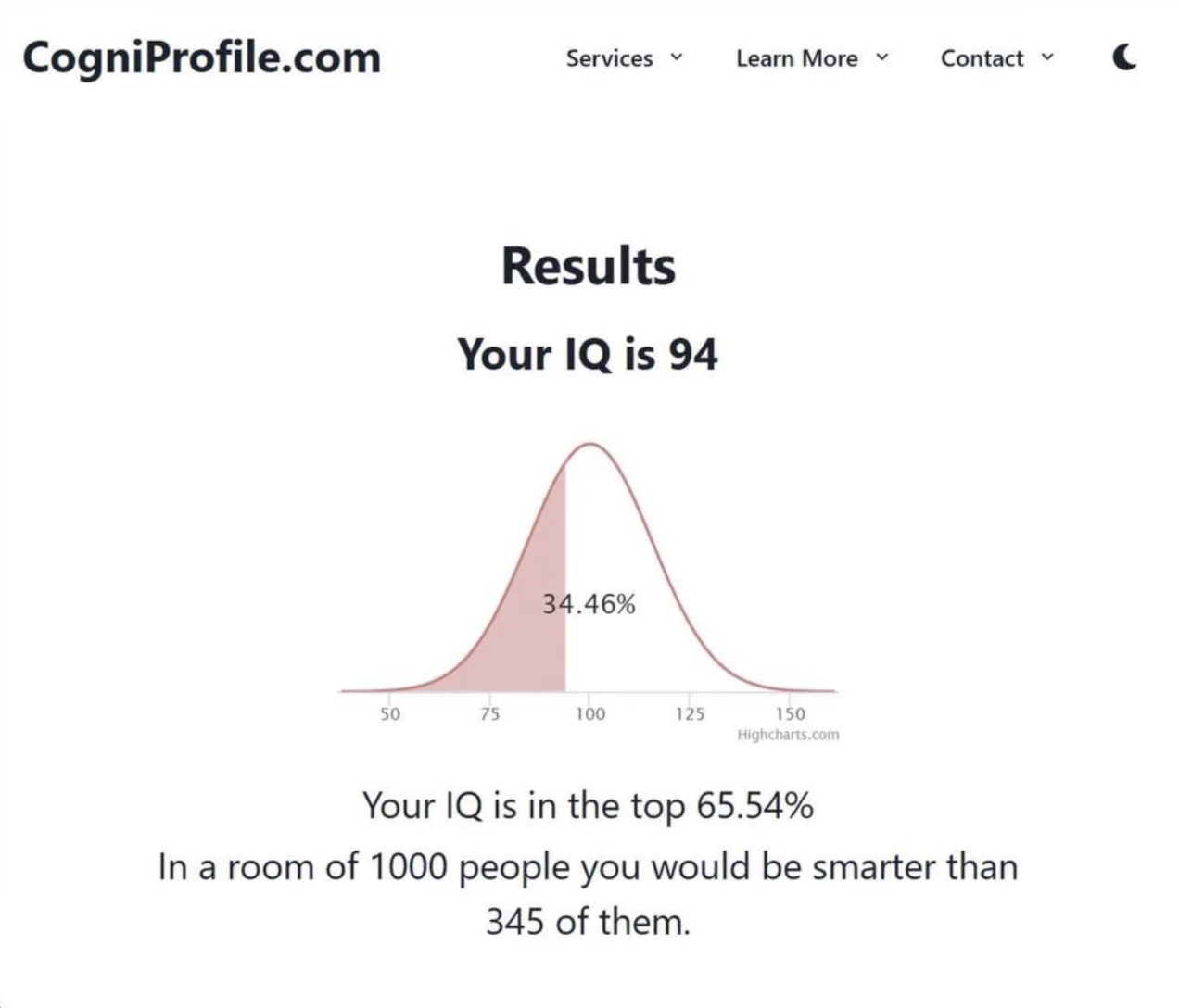
IQ is just one factor of intelligence, and not even the most important one. And even so, 94 is only just below average, it’s not so bad.
Just curious, what’s the most important one?
Sexiness
Rizz
Humans are social animals. If you can’t rizz your bosses to promote you and your coworkers to help you, then you’re stuck and alone.
NO RIZZ??
And connections.
I’d say EQ (emotional) is more useful on a daily basis
Maybe, but I don’t know if that’s a good thing. Social intelligence is how CEOs and other charlatans get disproportionate success in society, and if all we had was social intelligence humanity would be nothing but smooth-talking cavemen.
If we all had emotional intelligence, we’d be good at seeing through the shit of smooth-talking cavemen.
Good point.
We almost all have, but those without (at least those with ego problems) hone their skills their entire life to fool everyone else. IMO.
People often say that psychopaths act like they do because they don’t know how it makes people feel but the opposite is actually true - they know exactly how other people feel which is why they’re so good at manipulating them. They simply just don’t feel bad about taking advantage of that.
There is scientific evidence for the existence of emotional intelligence, but it not yet clearly defined nor easily measured.
https://www.sciencealert.com/scientists-weigh-in-on-the-evidence-for-emotional-intelligence-in-humans
It mainly exists as a tool for consultants to extract fees from corporate clients.
My only weakness! (Well also bright lights, rough textures, certain sounds…)
I put more points into my Wisdom stat.
A thorough test made up of several tests can give a full scale IQ with component scores. Big gaps in the scores, like between verbal intelligence and working memory or processing speed, even helps us detect ADHD.
I feel like I need high processing speed more than anything else when playing competitive video games.
I think those thorough tests are (as you also suggested) mainly used as a diagnosis aid for conditions like ADHD which can manifest as discrepancies between the component scores. In neurotypical people the component scores are AFAIK generally strongly correlated (that is to say, basically the same).
Krombiception, of course.
…you do have krombiception, don’t you?
Imo definitely common sense, which might not be a formal category of intelligence, but it follows from empathy, risk assessment, and understanding of consequences. Sociologists could probably do research to nail down an exact definition through and psychologists could probably measure it, though I suspect it would only really work intrademographically. What’s common sense for a rich, well spoken, fourteen year old white girl is different from common sense for a poor, uneducated sounding, twenty five year old black man, because they unfortunately face very different potential consequences for the same actions.
As a really rambling example (sorry!)
When I was the former in the US, I used to seek out and make conversation with cops if I was planning to buy or carrying (well sealed and odorless) weed at an event, because I figured they’d think I was less likely to do that if I was committing a crime, so they’d be less suspicious of me/give me more leniency if they caught me (because police corruption is a fractal: any amount of positive or negative interaction with them confers exactly that amount of forbearance or spite in future interactions). That’s terrible common sense for the latter demographic, but it worked very well for me and most of the white stoner girls I knew. Even the same demographic but older has different ideas of sensibleness. I would never seek out a cop like that today, because: A) I know that the real reason it used to work probably has more to do with us having been young teenage girls recognizing their authority than with us seeming more innocent (though the corruption bit was right), and wouldn’t apply to a woman as old as I am anymore*; and B) what works best for my current demographic is just blending in (or I guess getting way closer to a cop, but that’s both skin crawling and a much longer game than I am willing to play).
/* I’d argue it’s partial credit for common sense there and partially luck that my theory had positive consequences in common with reality, but this exemplifies the problem of letting each demographic decide for themselves what constitutes “common sense,” and use it as a metric for correct behavior /** (I’m sorry about the footnote within a footnote, my ADHD meds just kicked in on a day when I have nothing to do for the first time in over two months, after just finishing teaching a six week long German intensive course, teaching the same group for four hours every weekday, and the fediverse is the victim of my hyperfocus today).
Common sense might convince an adult not to trust the extremely rare sketchy-seeming but totally genuine opportunity, but it might also convince a teenager to trust the teacher or other adult entrusted with their safety who’s willing to buy them alcohol and nicotine products. However, if we allow people to weigh in for all of their younger demographic counterparts, we would risk making common sense impossible for all but the most mature people, thus making it no longer the metric we’re looking for.
/** it’s not really an issue for our definition or measurement of it though, it doesn’t really change things if common sense is sometimes wrong
Excuse me, it’s a quotient not a factor.
Technically not even below! The average is 85-115 IQ.
Isn’t the average 100 by design?
And also by definition of what an average is?
It’s not an exact science for starters so a +/- 5 points seems a likely margin, but I guess its just inside one “deviation”. 125 would be at +1 and so on (just making example numbers here).
deleted by creator
Can we please do this without the ableism? The US government is bad because the people are evil, not because they are stupid. Even if ostensibly they are both.
Good point. Thanks. I’m gonna self-delete this and take it as an invitiation to reflect on ableism.
You can say that, but it doesn’t make it true. I don’t think most of them are evil, and given their position they’re probably above average intelligence as well.
True evil is when causing harm (or suffering) is not merely a means to an end, but the end itself - the person derives pleasure or satisfaction from the act of harming others, independent of any larger goal. They don’t rationalize it as “necessary” or “for the greater good.” The suffering is the point.
Which is fucking pointless to point out because 80% falls into that 15 point deviation.
If you want true average, a 5-6 point deviation is more useful. Especially given the vast difference between someone with an IQ of 86 and the IQ of 114 - former will be failing most of their classes whereas latter will be excelling in most (not accounting for other personality traits that affect scholarly results, of course).
No, ~68,3% fall into that deviation.
Given that tests only approximate the real value and that there are errors and biases, being too exact wouldn’t serve you any function.
But I think you are right that a deviation of 30 from under to upper limit of average IQ is pretty big.
A range can’t be an average
it’s neither bad nor good, it’s just a relative score. If everyone except you was einstein then your IQ would be 1, but that doesn’t magically make you dumber than you are now.
Basically everyone is constantly getting smarter (due to stuff like education and better access to food), so you can’t even compare IQ scores over time
IQ tests test for many aspects of human intelligence. Any that would apply to the education system. IQ is usually separated into these groups so your overall result would show 94 general, 120 social, 84 spatial reasoning, etc…
That said, yes. 94 isn’t an indication Special Education is warranted.
deleted by creator