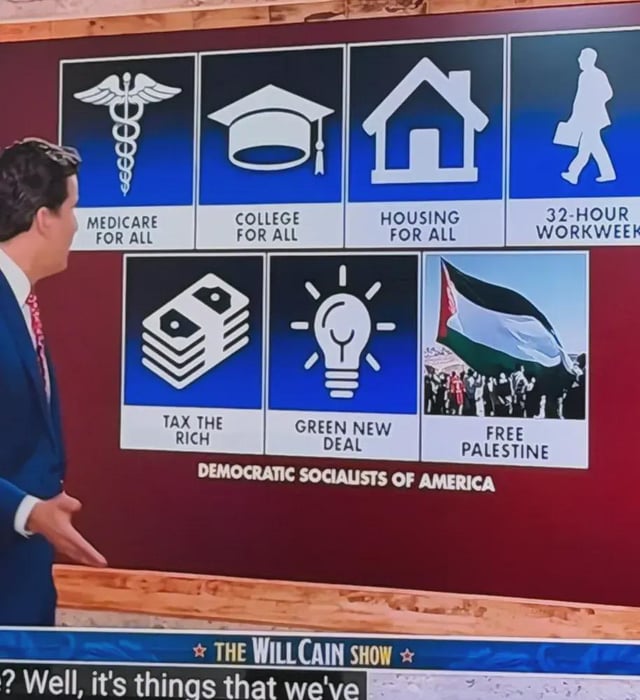
Oh no! It’s… European centrist?! And a rogue Free Palestine with a steel chair from the corner!
These are a bit too left-leaning for European centrists. Especially the 32-hour-workweek, even in the most “socialist” European countries this is a position only taken by dedicated “leftist” parties.
In France we have a 35 hours workweek, and our centrists fight that with all their might.
Imagine being so In love with the billionaires that you want less free time
My day job is unionized and it’s 35 hours per week. 🇨🇦
In the UK I think it averages 37.5 hours for salaried jobs. I haven’t looked that up.
I’m in the UK, 35 hours a week, with a compulsory 1 hour lunch break. University life… It’s flexible though 08:00-16:00 through 10:00-18:00. As long as you get seven hours in.
That’s pretty good, though legislation says they only have to give you a 20 minute break, and only if you work over six hours. Otherwise, 37.5 tends to be standard.
If you have enough time to think, that means we can strip you down to a 15 minute break
Thinking is clearly inefficient!
Is it? The average work week in the Netherlands is 30 hours. That is the current status quo, not even what the “left-leaning” parties propose for the future.
If it’s about the same as Germany, then the reason for that is that there are a lot of part time workers, who often don’t get enough money to be able to live off it on their own (e.g. married people, single parents who also get government assistance to make up the difference). That’s very different from declaring the full-time work week to be only 32 hours.
It’s somewhat similar to Germany, yes, though Germany has fewer part-time workers. In Germany (where I also live) the default options are 35 or 40 hours, though it’s becoming more common to have options to work less even in “full time” type of jobs.
Anyway, I doubt the “democratic socialists” in the USA want to ban working more than 32 hours, they just want people to have the same option people have in rich European countries.
Anyway, I doubt the “democratic socialists” in the USA want to ban working more than 32 hours
They want 32 hours to be legislated as ‘full time’ – meaning that employers legally must pay overtime (1.5x normal wage) for any amount of time worked over 32 hours per week.
This is already the case for 40 hours, but they want to reduce the number to 32.
If this is what they want, it’s really not very well thought through. Employers can just pay the same amount for 40 hours (paying less for the initial 32 and more for the subsequent 8), and employees will have greater incentives to keep their working week at 40 instead of having more flexibility for work-life balance. This would discourage 32-hour work weeks except for those jobs where employers can easily hire more people to compensate for the 8-hour shortfall (and those jobs are very few in number).
In fact, in Europe it’s usually the opposite, where overtime is more heavily taxed, so both employers and employees have incentives to keep the work week within sensible hours. In addition, overtime tends to be restricted by collective wage agreements, which, in contrast to the USA, often apply to non-union members.
Employers can just pay the same amount for 40 hours (paying less for the initial 32 and more for the subsequent 8)
They’re going to have a lot of very pissed-off employees when they announce the company-wide pay cuts. And competing employers who instead use the strategy of dropping to 32 hours and hiring more employees to make up the difference are going to be able to pay the full rate without any pay cut, making them more attractive to workers.
Also … ask yourself, why aren’t they already doing this to get 50 or 60 hour work weeks out of their employees? Because it’s hard to find employees willing to work below market rate for 60 hours a week. (Most employers already strictly limit employee hours, because they hate paying overtime.)
Now, what you’re saying isn’t completely insane – I do recognize that some employers may try to do something similar to what you’re saying, while trying to justify the pay cuts as a reaction to the new law. Also, there’s nothing forcing them to increase the hourly rate, so for a lot of workers going to 32 hours instead of 40 would be a significant overall income reduction.
There will be some friction, especially at first, but I think that over time, the market will normalize around it, and (essentially) 4-day work weeks could become the norm. It’s nothing that hasn’t happened before, during the fight for a 40-hour 5-day workweek.
The average work week in the Netherlands is 30 hours.
It’s a skewed bullshit metric though and you can’t compare it to most other countries.
It’s quite normal here to have one member of a household working 40 hours and the other part-time, for example 20 hours. That’s 60 hours of labour for a family and indeed 30 hours on average.
Unfortunately most statistics only include people who actually work, instead of the total potential workforce. So a traditional family where dad works 40 hours and mom stays at home will have a combined total of 40 working hours vs our 60. But because mom doesn’t work she is ignored and the family counts toward the average for 40 hours. So they go into the books as hard workers and we are just lazy sobs.
The cherry on top: statistics often cut off around 60-62, while we can’t retire until 67+.
Remember: there are lies, damned lies and statistics.
In this case the median would be a lot more interesting than the average. Few do more than 40h (legally) but many do less -> the average always under 40. Similarly, in average men have less than 2 testicles, but >99% have 2.
If the median is 40, then it still means that over half the population have 40h weeks meaning it’s the standard.
The median employee in the Netherlands is just barely at the threshold of working full-time (defined as 35 hours or more). Few of those who work full-time cross 40 hours, and part-time can be well below 30; the average comes out to about 30.
Of those working part-time (less than 35 hours), about 12% would like to work more but has no suitable work available, so these are underemployed people working part-time.
But what’s the legally defined full work week? If legally the full work week is 5 days you don’t have a 4 day work week, you just have enough privileged people and part time workers to bring the average down to 30.
I don’t know if there is a “legally defined work week.” The “average work week” is just the average hours worked by anyone performing paid labour, which includes part-time workers, who consist of about half the workforce.
So I did some quick digging and it does seem that there overall work week in Netherlands is rather flexible. That said I did find this from Arbeidstijdenwet:
2 The employer organizes the work in such a way that the employee aged 18 years or older at most work performed during:
a. 12 hours per shift;

b. 60 hours a week, and

c. average 48 hours per week in each period of 16 consecutive weeks.
Legally the upper limit you can work in a week is 48 hours. But that’s the upper limit and not what is happening in practice. So I looked that up as well. For full-time employees I found that men average 38.4 hours and women average 35.0 hours. The average work week of 31.9 hours doesn’t mean Netherlands has 32 hour work weeks, it’s just skewed lower primarily by part time workers.
It’s only a position taken by the Democrats in the U.S. because it’s something that will safely never pass. Kinda like in 2020 when we had candidates promoting Universal Basic Income.
Didn’t even get a clip art icon for them.
The horror! Won’t someone think of the rich who profit from each of these vital services?!
*Profiting from the privatization of these vital services, thereby guaranteeing that those services are degraded to the lowest quality possible while reaching the smallest number of people possible while most of the funds reach the pockets of the people at the top.
As long as a profit motive exists, that motive is that the person at the top gets as much of the money possible, while the people who the services are meant to serve always get the absolute least as is possible, and what is possible continues to diminish until it reaches zero.
I am starting to feel that Fox news is for the filthy rich to watch and for people who are deluding themselves into believing that, one day, they will also become filthy rich.
Most filthy rich people don’t watch it I’d say. It’s literally made for idiots.
If you just give someone a Palestine for free, what incentive will they have to work?
Principle’s office. Now.
The way to remember if it’s “principal” or “principle” is that the one that’s a person is your princi-pal.
You are my hero. Been mixing that one up since grade school
deleted by creator

Free Palestine? Hell, I’ll take two!
I don’t know, have you seen it lately? It’s a Fixer Upper.
The older generation is so selfish they don’t want the younger generations to get something “easier” than they think they had it. “I walked uphill both ways in the snow” kind of thinking. Most privileged generation.
Good luck being distracted by age. That’s almost as bad as red/blue state bullshit. Sure, the people in power in those states is making a difference, but my point is there’s a huge mix of people in every state. And in the same way, there’s plenty of old progressives and young fascists.
Constantly putting this crap on older generations implies you’re one of the ones hoping the problem will die off.
It won’t.
And distracting you from realizing that is the big reason for the push for “boomers” to equal “evil”. There’s a lot of idiot evil boomers, but there’s plenty of young idiot evil fascists.
The problem ain’t gonna die itself away. We must fight.
The problem ain’t gonna die itself away. We must fight.
And teach. We’re fighting ignorance and intolerance. We all gotta learn
Critical Thinking Skills are the best offense against propaganda.
I’ve been hearing that the Republican Party will wither from attrition as they all die off for 50 fucking years. We should be free of them by now, but instead they’ve taken over everything.
I always tell people to remember back to that first big protest in Chancellorville, when all those neo-Nazi fuckwits marched in with their tiki torches, chanting “Jews will not replace us”. ALL those weenies were under 40 years old. Rush Limbaugh and all the other psychopathic propagandists have been great at recruiting and indoctrinating new psychopaths into their ranks, and replacing all the old psychopaths that finally got dragged to Hell.
You don’t understand Christianity. Christianity is the religion of the police state. Revelation 22:15 encapsulates the notion of how the sinners are surrounded, with everyone who loves AND practices lying (not TO) being the undercover cops. Jesus’ crucifixion let us see who the idoltarers were, and cost one Roman soldier with a spear a promotion. I guarantee those tiki torch fuckers were 80% cops. The Proud Boys are feds. I know this because the joke is I had to be a crackhead because I wasn’t good enough to be a pothead, which is a festival cop.
This is sorta the same defense as “#NotAll(X)”. Because, like, yeah, obviously there are plenty of older progressives. But… The issue at hand here is one of power. Older generations have more wealth on average and hold more conservative views on average. It’s sorta on them to use their positions to make lives easier on those younger and less fortunate than themselves, and unfortunately for the rest of us, they are less likely to do so. And I say this with a boomer grandma doing her fucking best protesting outside ICE facilities.
To pretend there isn’t an age bias is silly. To pretend there is only an age bias is also silly. But it does exist, interrelated to wealth and power disparities that everyone is suffering from. So, you know, fuck boomers. If you don’t like hearing that, then really reflect on what that says about you.
In closing, yeah, the problem won’t simply die away, but I ain’t gonna pretend it doesn’t help, even if it isn’t every boomer’s fault.
The point that you are glossing over and dismissing as a minor one is Central to my theme: the problem is not going to die itself away.
Most of the people riding off boomers assume that all the youngsters are progressives. They are not.
Nowhere did I say boomers are equally as progressive as any other group. There’s a reason I didn’t say that. There’s a reason I said the other things that I said.
I don’t think everyone is saying the youth are all progressives, either. I think the only people saying that are conservatives.
The problem will get better with people dying of old age, though. You can’t really deny that.
Around 44% of Boomers consider themselves conservative.
Around 33% of young adults do.
Go ahead and wait around while the fascists only increase the propaganda if you think that’ll help, but in my humble opinion, that only falls into their trap. They get us to wait while they keep fighting tooth and nail.
I don’t think I said anyone should wait, though.
And young people aren’t doing enough to push back either, so fuck youth too.
True, but I think if we’re going off pure numbers, fuck men. Like, they are doing the least outta all these groups.
Thinking in labels is inherently dualistic thinking. The brain processes entanglements, and it is möbiated entanglements, that which the Buddhists called “defiled” that manifest the illusion of the self. This is giving a string a half-twist to create dualistic dichotomy (inner/outer). A form of möbiation that would take a minute to explain, but can be summed up in the phrase orthogonal relativity, and this picture, is what allows the brain to process an eleven dimensional topological matrix. Yer a knot, Neo. Enlightenment is being the effect before the cause - developing your prefrontal cortex to predict and outclass the animal parts of the brain, and resolving all karmic debt to demöbiate all your mind back into a unified field of entanglements.

Last night at dinner boomer maga: “why aren’t the kids drinking anymore?” Me: well we got like 10 jobs and have no time so i imagine they have like 20 jobs even less… “we used to go to work hungover”… oooooookay
Twas the Homer Simpson generation, meanwhile we’re all Frank Grimes
How about getting a single DUI will absolutely ruin your life? I’m so paranoid about drinking that I NEVER drink when I’m out for dinner. If a cop pulls me over, I want to be able to say “I haven’t had a single drop to drink.”
Besides, what’s wrong with people drinking less? Not smoking and drinking are two of the best things you can do for your life. This guy wants young people to fuck up their lives, so that he feels better about fucking up his?
It’s funny that you think not having a drop to drink will prevent the cops from arresting you for DUI with a 0.0 breathalizer anyway and the DA from prosecuting you despite an additional 0.0 blood test.
Their finding out the hard way that nothing lasts on this Earth and that death always comes to reap its due.
My favorite activity for a minute now is to ask people the definitions and differences between socialism and communism. It’s entertaining.
o0o in a similar vein, i like to ask them if they are pro fascism or anti… reminding them that they really only get to pick one… and watch them squirm as their programming conflicts
which is hilarious as they generally also couldnt define fascism if their life depended on it
I once explained some socialism ideas on Reddit. One user called me a communist, another a Nazi. It was a very confusing pair of responses but said more than either would ever know.
Because outside of a class room the terms are meaningless.
The PRC is still officially Communist, and has billionaires.
North Korea still claims to be a communist state too,
It’s more interesting to look at things like the USSR before, during and after the New Economic Policy period. Or, to look at the USA at the time when policing was outsourced to the Pinkertons. Or, at the UK when firefighting was a for-profit enterprise.
It’s not technically communist (yet), but it is supposed to be socialist (“with Chinese characteristics”).
And another person proving my point.
Tbf, Maoism was certainly more aligned with communist principles, though with their entering into the global capitalist marketplace they’ve certainly morphed quite a bit. They still maintain a unilateral top down structure and control, while allowing their citizens to benefit from certain elements of capitalism.
You just proved my point.
lol Communism with a smidge of Capitalism Characteristics
But you’re wasting their time, and yours.
Instead say, “I like this candidate. She wants to tax the rich.”
Health care ? Stable economy ? You really want that ?
You’ll end up just like Boomers with fancy “pensions” and “cabins” and happy grandkids DO YOU REALLY want tha… yeah that sounds pretty pretty pretty good comrade.
Soon enough it’s going to be “Food? Clean water? Those aren’t in the constitution, that’ll be 50 dollars for that small bag of rice, cash or klarna?”
Klarna or
physical enslavementprison labor?They’ll put a tax on oxygen after
What blows my mind is that basically all of these fit in with fiscal conservative ethos.
- Healthcare would benefit the most from economy of scale, which is the bedrock of corporation above the mom and pop level.
- Education is literally capital reinvestment for sustained growth.
- Housing is a commodity like like any other.
- 32 hour work weeks are scientifically proven to increase productivity and decrease Fraud, Waste, and Abuse.
- Taxation is another instance of capital reinvestment for sustained growth. Hell, it’s (demi-god of capitalism) Henry Ford’s “pay the line workers enough to buy my products”.
- The Green New Deal is not quite as cut and dry, but there is plenty of both “leveling the playing field to promote free market competition” against fossil fuel subsidies AND capital reinvestment.
Palestine opens a whole other can of billions of dollars of foreign government spending separate from the ethical concerns, which is less clear cut on market economics and would need to be an essay by itself. So I will just stick with the 6 out of 7 low hanging fruits for this argument, and mock the completely not fiscally conservating mess the Republican party has become.
The conservatives abandoned ethos long ago in favor of being against everything the progressives are for.
One of the bits that blew my mind was watching foreign politics and learning other countries have right wings further left than our own left. Fucking Overton windows.
Green New Deal is also incredibly sound economics and conservative ethos. Economically speaking, which is better: something you have to spend a bunch of time and effort mining for and then can only ever use it once or something you spend a bit more effort mining and manufacturing, but then can receive gains off your investment for decades? Gains that exceed your initial investment well before expected end of life.
And that’s just the economics of the gains; completely forgoing the cumulative costs burdened upon society by climate-change (increased heating/cooling-costs, early deaths because of pollution, crops failing and the mass-migration as a result of that). Continuing with fossil fuel is very very dumb if you look at the medium to long term.
For sure, but I focused on just the easily quantifiable economic returns because most people who would call the Green New Deal the Green New Scam are also climate change deniers. So, focusing on just their own pocketbooks with things that can easily be measured and calculated seems a better approach.
True, although we shouldn’t pretend that the cost for building a coal mine or developing an oil field is more single use than a solar farm or wind turbine. Many oil wells and coal mines operate for decades with relatively small operational costs after initial build out. Time in production difference is not statistically significant enough to make that a linchpin argument.
The jobs created by solar and wind in R&D, manufacturing, and construction and maintenance, along with most importantly the carbon emissions benefits are the most relevant economic points. Nuclear should also be part of the Green New Deal, but fossil fuel companies successfully fear mongered that sector to death.
There was a time where I was moderate, willing to believe the word of conservatives who said they wanted fiscal responsibility. I now know that they are craven liars, and have become fully radicalized.
Preach! I still consider myself to be a moderate or centrist as a leftist libertarian (social progressive and fiscal conservative), and also haven’t believed Republicans were actual fiscal conservatives since Bush Jr. They have been only social conservatives since arguably at least Regan. Still pissed off that insane Ayn Rand utopian individualists and Christian Nationalists became the entire libertarian movement.
Healthcare would benefit the most from economy of scale
would it? i’ve had far worse experience in large medical systems than i have in small clinics.
From a customer service standpoint, no, but I was talking about the cost perspective. A single payer system financing small clinics would be the best answer here, getting rid of the corporate hospital impersonality while keeping costs low. If a doctors office doesn’t have to deal with the insurance middle men and pharmacy middle men who are parasitically draining the system, you will have more neighborhood clinics and hospitals that care about their city’s residents.
Bro didn’t have an icon for Palestine
Their graphics team is working on an icon of bombs landing on kids probably.
Faux news doesn’t have one already?
It’s just the American flag
That’s just the default if you ask GPT to generate “Palestine Icon” with no descriptors.
Socialism!
Ooohh. Say it again!

If you see this and think these things are bad things to have in your country, you are seriously fucked in the head and I hope you die a horrible death from colon cancer.
Terry? 🤔
HOW DARE THEY GIVE THE AMERICAN PEOPLE LITERALLY EVERYTHING THEY EVER WANTED!!!
AAAAAAAAAAA!!!
😂😂😂😂😂😊😂😂😂😂😂
Removed by mod
if they had room on the graphic, it’d be there too… but their racism runs deeper, and just think of all the black and brown people that would benefit from these policies. they don’t care that “all” includes all the maga nuts, too, doesn’t even register in their minds… it’s just that “those” people… the “wrong” people… would get something–anything, is just too much for them to handle.
OK, that clinches it. I’ve had a feeling since the first time I saw this graphic that there was some sympathetic background worker at Fox News who purposely made the thing look as appealing as possible. “Culture war” issues are still kneejerk, hot button topics for a lot of that audience.
Time to never vote for any of these candidates!
I’d say /s but that was literally many, many unironic comments in 2024
This is what the boomers most fear. Telling, huh?
I’m a boomer and want those things.
My parents are boomers and they want these things. And most people in their circles are the same. So I really get annoyed when I see this sentiment online, especially on Lemmy where you’d think people would know better. A lot of MAGA support is coming from younger people. Why do you think that Kirk dickhead was at college campuses, not retirement homes. These are people who are not anti vax because they grew up with polio. They support unions because they have seen them work.
Eh, plenty of Boomers will say they want those things but then shoot down any attempts at them as “not the right way”. These are the kinds of people who showed up to the Democratic primaries in 2020 and voted for Joe Biden. If they really wanted these things they’d vote in the primaries for politicians who are fighting for them.
Eh, plenty of younger people will say they want those things but then decide not to vote for the Democrat candidate who made it as the nominee because they didn’t pass some purity test. And that hands power to the fascists.
I voted for Biden. And Clinton. And Harris. In the general election, because not doing so was a vote for fascism. I also voted for different people in the primaries because that was my chance to vote for a progressive.
To be clear, you’re trying to deflect blame away from people who show up to the Democratic primaries to vote for strike blocking, genocide supporting geriatrics yes?
Wut
I didn’t stutter. Do you lack basic reading comprehension?
The purity test of… not doing a genocide??
Imagine that before you stand two candidates. One of them supports genocide and corporations as people, but does occasionally manage to also support human rights. The other of them supports genocide and corporations as people, but also is working to break our democracy and replace it with fascism.
Those are your two options.
If you decide not to vote for the first one because they support genocide, then you are lending your support to fascism.
I would hope you would have supported a better candidate earlier in the process, but the point is that when faced with the final voting options, many people withdraw from voting because they don’t like the candidate that is of the party that they would support if they did like them.
And so the fascists win that voter’s voting power, essentially.
Worth noting that I’m not talking about earlier in the process because the above scenario is an extremely simplified version of what our options have mostly been.
Then the country deserves to be sanctioned out of existence and balkanized. Sorry about your shitty situation. Death to America.
As with any generation, many of the people who were teens in the 60s did not like the depression- and war-torn, conformist, society they grew up in, They had much different values and music and politics and approaches to life. Yes … today they’d be called democratic socialists, they showed up for Sanders’ tour. They don’t watch what Mideas Touch calls the ‘Regime Media’. The Repubs are running scared about the midterms, for a good reason.
Thinking everyone in an earlier generation is to blame for anything today is wrong-headed and the result of just not knowing enough about history.
Yeah, I had relatives that grew up with polio, etc. They (and I) are very pro-vax!
Good, I’m glad you’re one of the decent ones.
Who did you vote for in the 2020 Democratic primaries?
This is Fox telling them what to hate.
Anybody has the video? I wanna know if this is real and if it is I wanna see them try to spin that the bad way.
Clown world is the only place this could not be a joke. Like what else could they have on there? Free oral sex on request? Support for kittens?